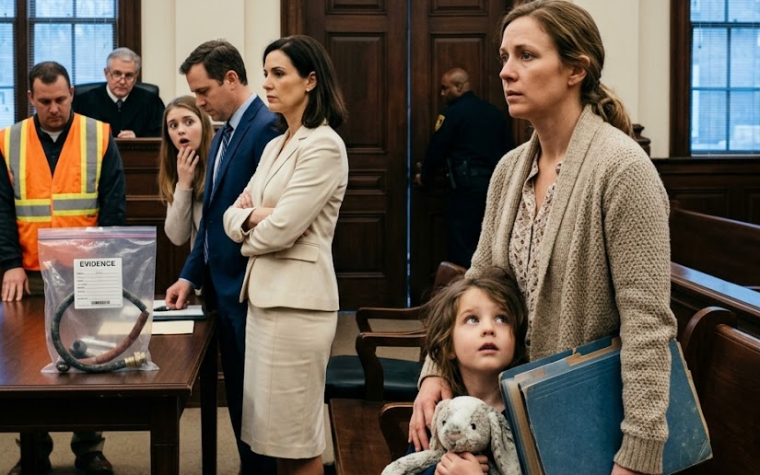
The same man who had once dismissed me as an aging widower now studied my face every time evidence was discussed.
He had finally learned what silence meant.
Silence was not ignorance.
Sometimes it was observation.
The prosecution’s reconstruction was devastating because it was simple.
Grace had been taken outside against her will.
Nathan had been restrained where he could see the lake.
Maren independently witnessed critical portions of the event and called for help immediately.
Grace was found beneath the ice.
Vaughn possessed her wedding ring.
The brothers’ clothing and tracks placed them where witnesses said they had been.
And their explanations changed after they learned what investigators had recovered.
The defense attacked my age first.
An attorney asked whether pain medication for my knee affected my memory.
“No.”
He asked whether darkness could distort distance.
“Yes.”
He asked whether I could estimate forty yards accurately at night.
“Within a reasonable margin.”
He smiled as though I had helped him.
Then he asked how.
I explained that I had spent decades estimating spans, grades, sight lines, and structural distance before confirming them with instruments.
His smile disappeared.
They asked whether fear could cause people to remember events incorrectly.
I agreed that it could.
Then the prosecutor placed my drawing of the property beside photographs investigators had taken before fresh snow arrived.
The principal locations matched.
The deck.
The path.
The hole.
The sets of tracks.
I had described them before seeing the photographs.
Vaughn stared down at the table.
Grant began negotiating through his attorneys soon afterward.
Whatever loyalty had once existed between the brothers collapsed under the pressure of separate consequences.
Grant admitted his role in taking Grace onto the ice and acknowledged that the story about her wandering outside alone was false.
He attempted to minimize what he had intended.
But by then, intent was being measured against action.
Hollis could no longer plausibly claim he had been trying to free me when the marks, witness accounts, and sequence showed that I remained restrained while Grace was taken onto the lake.
The family machine had spent its life controlling narratives.
This time there were too many independent pieces.
Vaughn held out longest.
He denied wanting Grace dead.
He denied planning the night.
He blamed panic, confusion, Grant, and finally Grace herself.
The more he spoke through his defense, the smaller his explanation became.
Grace did not need to match his anger.
When she testified, she wore a dark suit and flat shoes.
She walked slowly because pregnancy had become harder after the lake.
She never raised her voice.
She described calling me three nights before the trip.
She described Vaughn’s reaction when she told him about the baby.
She described the sudden invitation to Lake Winnipesaukee.
She described Grant appearing in the hallway after midnight.
She described being forced outside.
Then she described Vaughn removing her wedding ring before she went into the water.