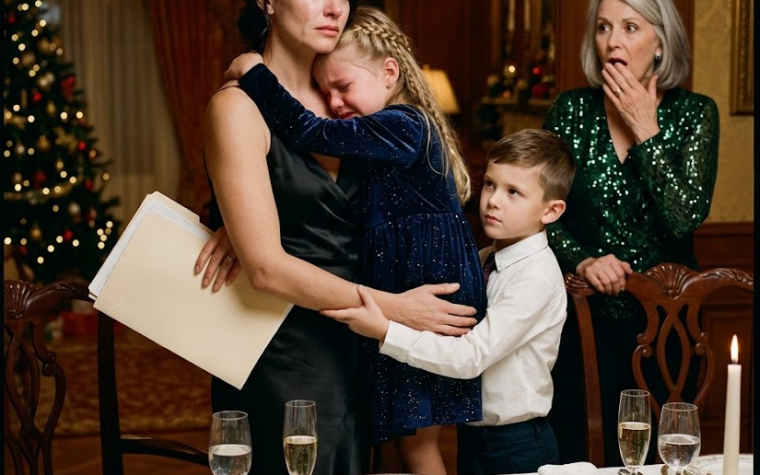
She had also attended what Walter called a private memorial at Meadowbrook, where an empty decorative urn had been placed beside the new marker.
Walter told her it would convince me to stop interfering if I discovered the plot.
“I thought we were protecting Mom’s assets,” Olivia said.
“Walter said Dad would lose everything if he stayed in control.”
Jennifer’s voice remained quiet.
“You protected my assets by taking away my husband, my phone, and my right to know where I was?”
Olivia lowered her eyes.
“No.”
Walter snapped his document case shut.
“This conversation is over.”
He reached for the handle.
A security officer blocked the door.
The detective told Walter he was not free to leave while they completed their initial inquiry.
When Walter protested, the detective asked him to explain why his email address appeared on attempted bank transfers, why my signature appeared on documents I had never seen, and why a false medical letter had been submitted to two institutions.
Walter stopped answering.
His silence was the first honest thing I had heard from him.
The investigation took months, but the immediate damage was stopped that day.
Jennifer revoked every authorization connected to Walter.
Cedar Glen released her to a rehabilitation program chosen by her own doctor, with me listed as her primary contact.
The bank permanently canceled the loan application and restored the funds Walter had attempted to move.
Specialists confirmed that several signatures and initials had been copied or traced.
Digital records connected Walter to the altered documents and fraudulent submissions.
He was eventually charged with forgery, attempted financial exploitation, fraud, and offenses related to restricting Jennifer through false medical information.
The false grave became one of the most damaging pieces of evidence because it showed planning rather than confusion.
He had not acted in panic after a medical emergency.
He had purchased a plot, commissioned a stone, staged a ceremony, and used my grief as a tool.
Olivia cooperated with the investigation.
She was not charged with the same offenses Walter faced, but cooperation did not restore what she had broken.
Jennifer and I met with her once after returning home.
Olivia sat at the oak table and apologized until the words lost their shape.
“I believed him,” she said.
Jennifer looked at her for a long time.
“You believed him because believing him gave you permission not to ask questions.”
Olivia began to cry.
I felt the old instinct to comfort my daughter, but I did not move.
Forgiveness, I learned, is not the same as immediate access.
Love does not require pretending betrayal was harmless.
We told Olivia that rebuilding trust would depend on time, honesty, counseling, and respect for boundaries.
She surrendered every key and copy of our financial records.
For the first time in eight years, she began making decisions without Walter beside her.
Jennifer came home six weeks after the phone call.
I had watered the roses every morning.
Her reading glasses were still on the arm of her favorite chair.
The lavender lotion remained in my truck until the day I drove her home, when I placed it in her hands.
She laughed and cried at the same time.
“You remembered.”
“I remembered everything.”
The cemetery removed the headstone and refunded the cost to the account from which Walter had taken the money.
Jennifer chose not to destroy the stone.
Instead, she had the carved dates ground away.
We placed it flat beneath the oak tree and covered it with soil.
Above it, Jennifer planted a pink rosebush.
The following spring, we invited her sisters from church, her former library colleagues, the neighbor who brought lemon bars, and the women from her gardening club to our home.
There was music.
There were stories.
There was too much food and not enough chairs.