“How much money do you actually have?”
I stared at the message for a long time.
Then I deleted it without answering.
That information belonged to me.
The greatest change was not that Garrett discovered I owned another house.
It was not that Celeste learned the woman she had dismissed as a nearly penniless retiree had resources she knew nothing about.
The change was that I stopped explaining myself.
I stopped apologizing before saying no.
I stopped treating every boundary as a negotiation.
My lawyer reviewed everything with me, including the consequences of the house I had already transferred.
I did not try to take it back through threats or games.
I had made that decision three years earlier, and I accepted it.
But a gift of property had never entitled Garrett and Celeste to the rest of my life.
That part was still mine.
I spent the first weeks of the new year turning my house into a home instead of an escape route.
I unpacked Philip’s photographs.
I placed his jewelry gifts in the bedroom.
I found a spot near the kitchen window for the old picture of Garrett blowing out birthday candles.
I considered putting it away.
I didn’t.
Erasing love would not make betrayal hurt less.
The photograph reminded me that two truths could exist together: I had loved my son deeply, and my son had treated me cruelly.
Neither truth canceled the other.
One cold evening, I baked another pecan pie.
The smell filled the kitchen, warm and familiar.
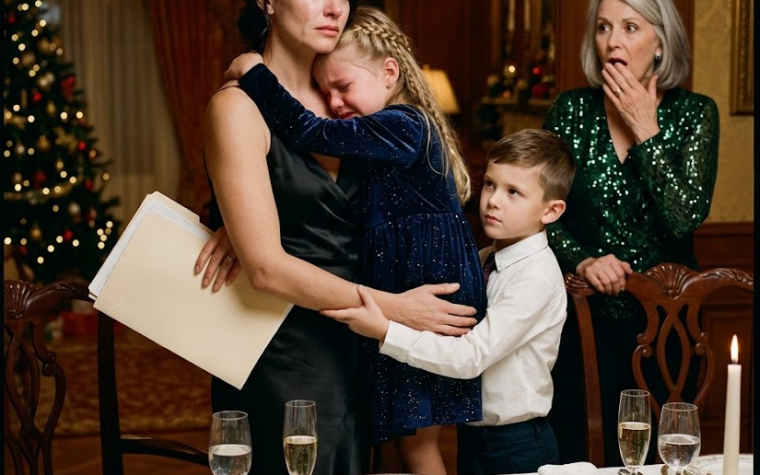
For a moment I was back at Christmas dinner with Celeste’s finger pointed at my face and Garrett smiling from Philip’s chair.
But this time there was no one waiting to humiliate me.
I cut myself a slice, made coffee, and sat at my own table.
The house was quiet.
Not the hostile quiet of that Christmas dining room.
A peaceful quiet.
My phone buzzed once.
Garrett.
I looked at his name, then at the pie in front of me.
I did not feel triumphant.
I did not feel pleased that my son had finally learned I possessed more money than he imagined.
There was no victory in discovering that someone you love behaves better when they think you are valuable.
What I felt was grief with its eyes open.
I had wanted Garrett to prove my lawyer wrong.
Instead, he had given me the truth.
And the truth, painful as it was, gave me something false hope never could.
A choice.
I picked up the phone.
This time I answered.
“Hi, Garrett.”
His voice was quieter than before.
“Hi, Mom.”
Neither of us spoke for a moment.
Then he said, “Can we talk sometime?”
I looked around the kitchen I had bought for myself, at the envelope resting inside a drawer, at the life Philip had helped make possible even after he was gone.
“We can talk,” I said.
“But talking and paying are two different things now.”
He did not argue.
That mattered more to me than an apology forced by fear.
I ended the call a few minutes later and returned to my coffee.
I never resumed the old stream of help.