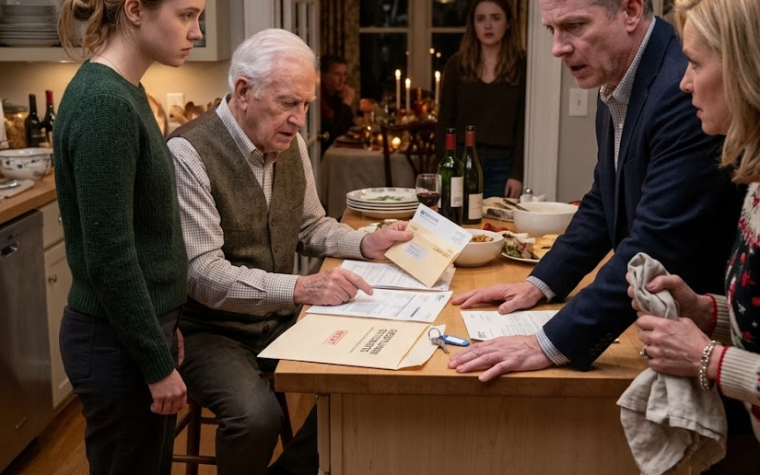
‘I don’t contact private owners for residents.’
‘We’re not residents now, apparently,’ Brenda snapped.
Her mother began crying.
Her father demanded their luggage, access to the unit, and the name of someone higher up.
Matthew barely heard them.
His attention had gone to the final item inside the envelope.
It was folded separately.
Not printed by management.
Not prepared by a lawyer that evening.
His name was written across the front in blue ink.
Matthew.
He knew the handwriting.
His mother’s.
Brenda saw his expression change.
‘What is that?’
He opened it.
The paper inside was older than the others.
The crease had softened.
Clara’s handwriting leaned slightly to the right, the same hand that had written his school lunch notes, birthday cards, college care packages, and the recipes she kept taped inside our kitchen cupboard.
Matthew began reading.
‘Matthew, if your father ever gives you this letter, it means something has gone badly wrong between you.’
He stopped.
Brenda reached for it.
He pulled it away.
For once, she let him.
He continued.
‘I hope I am wrong about the reason.
I hope you have grown into the kind of man who understands that what your father and I built was never a prize waiting for you at the end of our lives.’
Matthew lowered the letter.
His knees weakened enough that he reached for the lobby bench.
Brenda’s father said, ‘What does it say?’
Matthew did not answer.
He kept reading.
Clara had written the letter during the final months of her illness, when medication bottles collected beside her bed and ordinary conversations had begun carrying the weight of last chances.
She had known Matthew loved us.
She also knew he had begun measuring that love in rescue.
Every time trouble found him, he came home expecting us to make the consequences smaller.
We usually did.
Clara worried that one day he would stop seeing help as generosity and start seeing it as entitlement.
The letter said exactly that.
‘Your father will give until giving begins to hurt him.
He will call it patience.
He will call it family.
I know him well enough to know he may need permission to stop.’
Matthew’s face tightened.
Brenda whispered, ‘She wrote that about you?’
He read the next lines silently.
Clara had explained that the trust existed for security, not status.
The brownstone, the Washington Street arrangement, and the accounts we controlled were never guaranteed inheritances.
Access could be granted.
Access could also be withdrawn.
Most importantly, she had written one sentence twice, underlining the second version.
‘Love does not require surrender.’
Matthew sat down.
That was the moment Brenda stopped shouting at the manager.
Until then, she had treated the evening as a technical problem.