That was enough.
“No.”
“Not really.”
I laughed once, without humor.
“What did she say?”
“That she regretted how the situation escalated.”
Of course she did.
Even at the end, my mother couldn’t bring herself to use a verb with a person attached to it.
Not I grabbed.
Not I pushed.
Not I hurt you.
The situation escalated.
A sentence designed so responsibility could disappear inside grammar.
My father sent one final letter through Daniel’s office.
He said he hoped time would “restore perspective” and allow the family to reunite before Rebecca’s baby arrived.
I read it once.
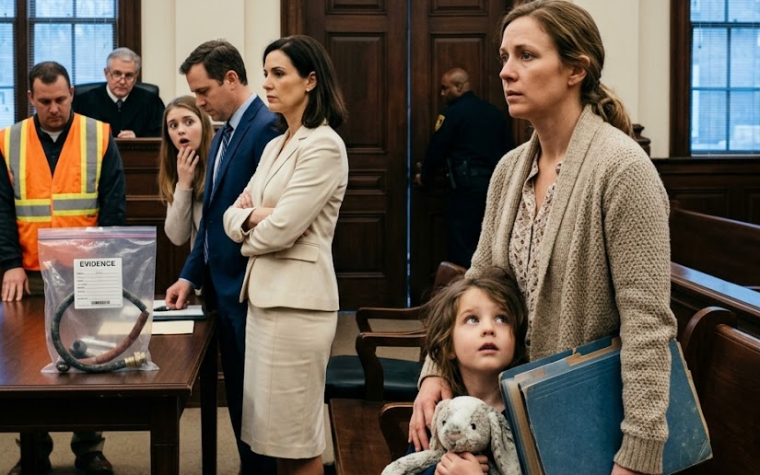
Then I placed it beside Rebecca’s message and the court paperwork in a folder.
For years, my family had trained me to question my own memory whenever their behavior hurt me.
Now I had statements, footage, messages, and documents.
But strangely, by then I no longer needed the evidence to convince myself.
The evidence had done something more important.
It had stopped them from convincing everyone else that I was imagining it.
Rebecca gave birth months later.
I learned about it from a mutual acquaintance, not from my parents.
I sent nothing.
No angry message.
No cruel remark.
No attempt to make her child’s arrival about what she’d done to me.
That distinction mattered.
I didn’t want revenge.
I wanted distance.
My father continued to treat distance as punishment because he couldn’t imagine a boundary that wasn’t designed to control somebody.
I stopped explaining it.
The restaurant manager later contacted me through Daniel to ask whether I needed another copy of the security footage before their retention period expired.
I already had one.
I told Daniel we could keep it with the case files and never watch it again.
He studied my face.
“You sure?”
“I remember enough.”
Then I finally opened the box in the closet.
Inside were the paper stars I’d ordered before the miscarriage.
Small folded shapes in cream, silver, and pale blue, each attached to nearly invisible thread.
For months, I had treated the box as if opening it would force me to choose between forgetting my baby and staying trapped inside the loss.
Neither was true.
I sat on the bedroom floor and held one star in my palm.
Daniel sat beside me without saying anything.
I cried then.
Not because my mother had pushed me.
Not because my sister had laughed.
Not because my father had raised his glass.
I cried for the child I had wanted, for the nursery I’d imagined, and for the version of myself who had believed she needed permission from her family to grieve.
A few days later, I carried one of the stars to my studio in Beacon Hill.
Kate noticed it hanging beside the drafting lamp but didn’t ask where it came from.
On my desk was the nursery project I’d closed so abruptly the morning my mother called.
Sage walls.
White oak shelves.