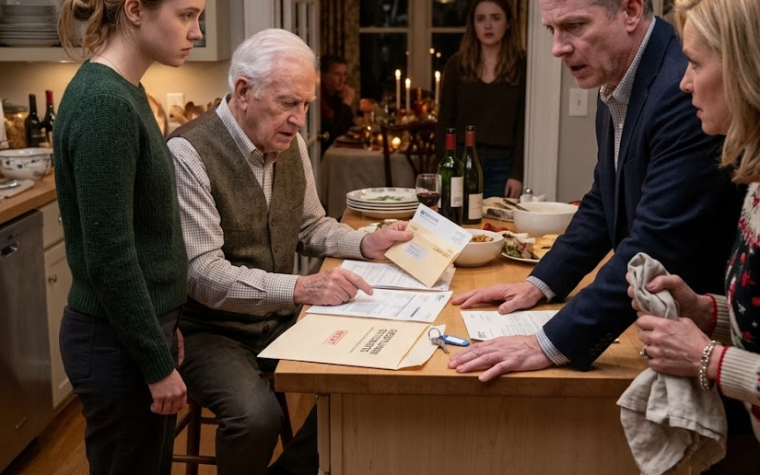
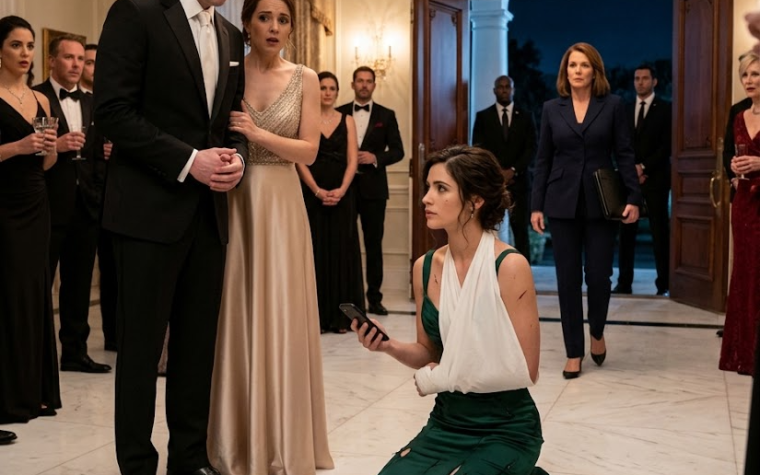
The lawyer placed Julian’s letter beside Camille’s signature and began reading the arrangement he had activated the morning after he overheard her conversation.
Camille stared at the first line.
Her fingers stopped trembling.
Her entire body went still.
The lawyer’s voice remained calm.
“Under the marital property acknowledgment signed by Camille Vale before the wedding, all shares in Vale Holdings, all assets held by the Julian Vale Trust, and all future voting rights remained the separate property of Julian Vale.
The same document contains an express waiver of any right to serve as executor, trustee, board representative, or controlling beneficiary.”
Camille looked down at the blue folder as though it had appeared from nowhere.
“No,” she said.
“That is not what I signed.”
The lawyer turned the page toward her.
Her initials stood beside each clause.
Below them was a paragraph stating that she had been advised to obtain independent legal counsel.
Another line recorded that she had declined additional review and wished to sign immediately.
Her signature crossed the final page in a large, impatient stroke.
I remembered that signature.
Camille had always signed her name as though the paper should feel honored to carry it.
“This is a prenuptial agreement,” she said.
“It does not decide the will.”
“Correct,” the lawyer replied.
“It does not.
It only confirms that you waived claims against assets held outside the probate estate.
Mr.
Vale’s controlling shares were transferred into his trust years ago.
The amendment to that trust is what decides who controls them now.”
One of the board representatives slowly removed his glasses.
Camille noticed.
“Why are you looking at me like that?” she demanded.
No one answered.
The lawyer unfolded a second document.
“At nine twenty the morning after Mr.
Vale overheard your conversation, he instructed this office to amend the succession provisions of the trust.
Two physicians later confirmed that he was competent, fully informed, and acting voluntarily.
The amendment was executed that afternoon in the presence of two witnesses.”
Camille’s eyes moved toward me.
“You knew.”
“I did not,” I said.
“Do not lie to me.”
“She was not present,” the lawyer said.
“She was not contacted.
She learned of this meeting at the same time you did.”
Camille pressed both palms against the table.
“Then read it.”
The lawyer did.
Julian had not left his four-hundred-million-dollar fortune to me.
He had done something Camille considered far worse.
He had made certain that no single person could own it.
The controlling shares of Vale Holdings would remain inside a stewardship trust.
Its income would support the hospitals already named in his will, the employee pension fund, and the foundation that managed his charitable work.
No beneficiary could sell the company, break it apart, borrow against its assets, or redirect the trust for personal use.
Camille would receive the amount specified in the agreement she had signed before the wedding: one million dollars, the jewelry Julian had personally given her, and no authority over the company, the foundation, the residences held by the trust, or the investment accounts.
The payment was also protected by a no-contest clause.
If she challenged the trust or attempted to interfere with its administration, she would forfeit the one million dollars.
Camille gave a short, disbelieving laugh.
“One million?”
The amount sounded obscene when she said it, not because it was small, but because it was not four hundred million.