Copies.
No conspiracy language.
No dramatic accusations.
Just facts.
“She didn’t call it a conspiracy,” I said.
“She kept records.”
Mitchell stopped moving.
That was enough.
I saw the moment he understood that whatever I knew had come from Megan herself.
Then he made his second mistake.
“Those records don’t prove anything.”
My father slowly rose from his chair.
“What records?”
Mitchell opened his mouth.
Nothing came out.
For the first time since the funeral, he wasn’t managing the room.
He was trapped inside it.
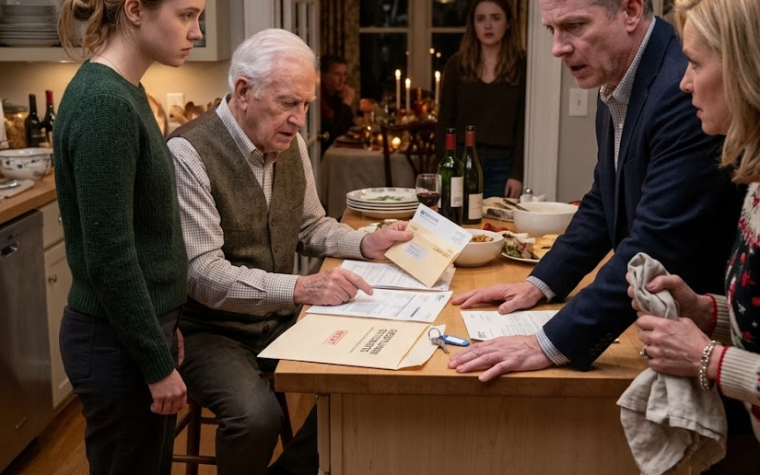
I didn’t show him the folder.
I didn’t tell him what Beth had said.
I didn’t give him the chance Megan had been afraid he would get—the chance to build an explanation before anyone checked the evidence.
I picked up the unsigned papers from the table and handed them to my father.
“Keep these.
Don’t sign them.”
Mitchell stepped toward me.
“You have no idea what you’re doing.”
“Maybe not,” I said.
“That’s why I’m letting people who do know examine it.”
He went completely still.
After that, events moved without his permission.
Preserved access records were compared with Megan’s timeline.
The pattern she had documented was real.
Investigators found repeated unauthorized access attempts associated with devices and connections Mitchell had used.
Financial records showed transactions and attempted transactions Megan had flagged long before her death.
Her notes proved she had noticed them before anyone had reason to invent a story around the funeral.
Beth’s statement did something equally important: it established the pressure behind the pattern.
She described Mitchell’s repeated questions about Megan’s passwords and paper files.
She described the dinners he had insisted she arrange.
She described his frantic search after the funeral and his demand to find the hard copies before the rest of us could review Megan’s things.
When confronted with the records, Mitchell denied everything.
Then he blamed Beth.
Then he claimed Megan had authorized him.
Then he said the accounts were family matters and therefore none of it should count as unauthorized.
Each explanation contradicted the one before it.
The calm brother from the funeral disappeared.
The man underneath him was furious that documents were being treated as more reliable than his voice.
The financial and access investigation eventually produced consequences he couldn’t organize his way around.
He lost control of the estate process, was barred from handling Megan’s accounts, and faced formal fraud and unauthorized-access allegations based on records independent of anything Beth or I said.
The investigation into Megan’s death was also reviewed because of the concerns she had documented before she died.
No one in our family was allowed to substitute certainty for evidence—not Mitchell, not Beth, and not me.
I learned to live with that distinction.
Megan had been afraid.
That was proven.
Someone had been entering places they had no right to enter.
That was proven.
Mitchell had known far more about her records than he admitted.
That was proven too.