I could finally give her a better answer than I had before.
“Yes.
Right now, she is.”
Jennifer came to see Lily only under the conditions of the safety plan.
The first time she entered our house after everything happened, she stopped in the doorway.
The changing mat had been put away.
The room looked normal again.
That almost made it worse.
She looked at me and said, “I’m sorry.”
I did not tell her it was okay.
It wasn’t.
“I need you to understand what you did,” I said.
“I do.”
“No.
You were scared of David, and I believe that.
But Lily couldn’t leave.
Lily couldn’t call anyone.
Lily couldn’t tell me what happened.
You could.”
Jennifer cried.
I let her.
For years, I had thought helping my sister meant making her feel less afraid after each fight.
Now I understood that comfort without truth could become another hiding place.
Jennifer had to cooperate fully.
She had to stop minimizing David’s behavior.
She had to accept that protecting Lily could mean losing the life she had been trying desperately to hold together.
And she did begin doing those things.
Not perfectly.
Not heroically.
There were days when she defended memories of David and then hated herself for it.
Days when she asked whether one terrible moment really meant everything had to change.
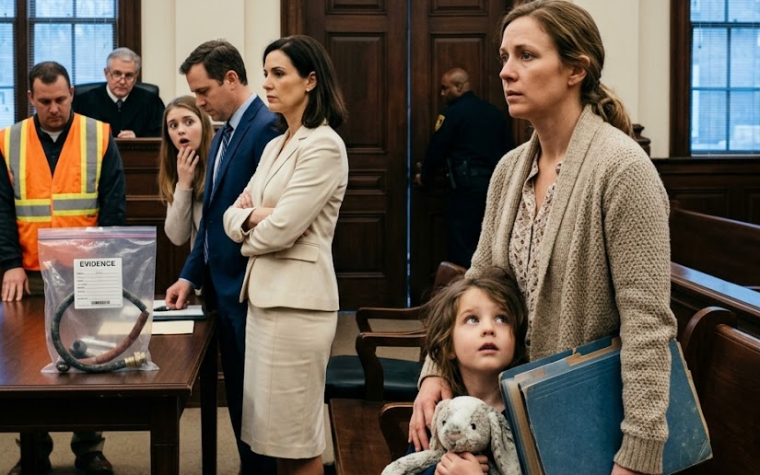
Whenever she started drifting toward that question, I thought about four bruises around a 2-month-old baby’s thigh.
Sometimes one terrible moment is enough.
The case did not end with a dramatic confession from David.
He continued denying that he had intentionally hurt Lily.
But denial was no longer the only story in the room.
There were photographs.
There was a timeline.
There was medical evidence.
There was Jennifer’s statement that she had watched him grip Lily before the bruises appeared.
And there was his own behavior when he entered our home: the calm scanning of the room, the hand on Jennifer’s shoulder, the effort to answer around her, and finally the attempt to blame her when he realized the hospital bracelet would not make the earlier hours disappear.
The legal process moved more slowly than my anger wanted it to.
Protection, interviews, documentation, hearings, restrictions—nothing happened with the cinematic speed people imagine when they hear sirens.
But the important part happened immediately.
David lost the ability to stand over Jennifer and decide which version of the truth everyone else was allowed to hear.
Lily was protected from him while the case moved forward.
Jennifer was forced to choose whether she would keep protecting the story of her family or start protecting her daughter.
And I was cleared of the accusation she had thrown at me in our own living room.
That last part should have felt like victory.
It didn’t.
There is no satisfying victory when the proof that clears you is a photograph of bruises on a baby you love.
Months later, I still remembered the ordinary details most clearly.
Pancake syrup on the kitchen counter.
Sunlight across the hardwood.
Sophia’s proud little voice saying, “Mom, look at this.”
Tom’s hand shaking around his phone.