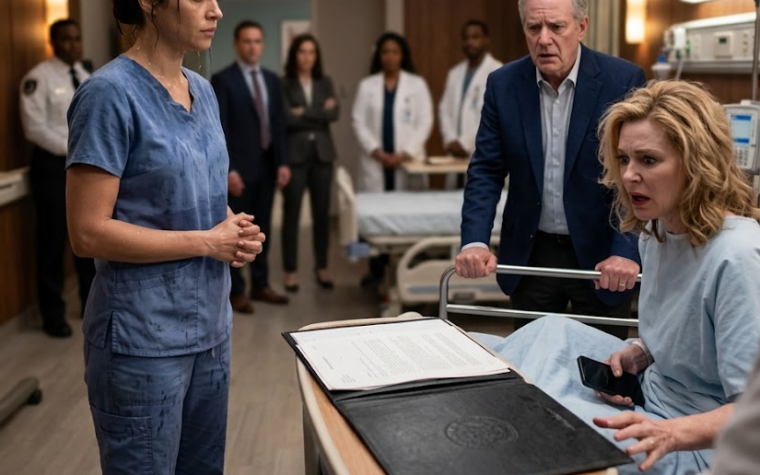
Brooke pulled it toward her and opened it.
The proposed agreement gave a company Mason controlled the exclusive right to purchase my property after the ninety-day restriction expired, at a price barely above the unpaid taxes and estimated repair costs.
She looked at him.
“You didn’t tell me that part.”
He snatched the folder back.
“It was a starting point.”
“You said we were helping her.”
“We were.”
I almost admired how easily greed changed accents.
Five minutes earlier, Brooke and Mason had been united against me.
Now Brooke was angry because Mason had planned to profit before she could.
Dad’s tape was still running.
“Last thing,” he said.
We all turned toward it.
“If this recording has turned into an argument, Whitaker, I owe you a drink.”
For the first time all night, Mr.
Whitaker smiled.
Dad continued.
“Clara, you don’t owe anyone a sale because they’re family.
You don’t owe anyone half because they laughed before they knew the number.
Take ninety days.
Walk through every room.
Fix nothing you don’t understand yet.
Then decide what the house needs from you.”
The tape clicked off.
Rain filled the silence.
Brooke slowly removed Mom’s pearls from her neck and held them in one hand.
For a second I thought she might offer them to me.
She didn’t.
Instead she said, “We should have another appraisal.”
Mr.
Whitaker nodded.
“Clara should.”
“We should all be present.”
“No,” I said.
Brooke stared at me.
It was the first clean no I had ever given her without explaining myself afterward.
Mason picked up his folder.
“You really think a box of coins changes who you are?”
“No.”
I looked around the kitchen—the peeling paint, Mom’s curtains, Dad’s old mug, the square opening in the wall.
“It changes what you thought I was worth.”
He had no answer to that.
Mr.
Whitaker supervised while I opened the steel box.
Inside were shallow wooden trays wrapped in cloth, each holding old coins in protective cases.
Beneath them were Dad’s purchase notes, insurance records, photographs, and earlier appraisals.
Everything was organized.
Everything was documented.
There was also a plain white envelope with my name on it.
I opened it after Mason and Brooke left.
Dad’s handwriting filled one page.
He told me the nine dollars made him laugh when the clerk explained the fee.
He wrote that I would probably spend more than that on coffee while trying to understand why he had chosen the farmhouse for me.
Then he wrote something that stayed with me longer than any number on the appraisal.
A house isn’t valuable because people fight over it after you’re dead.