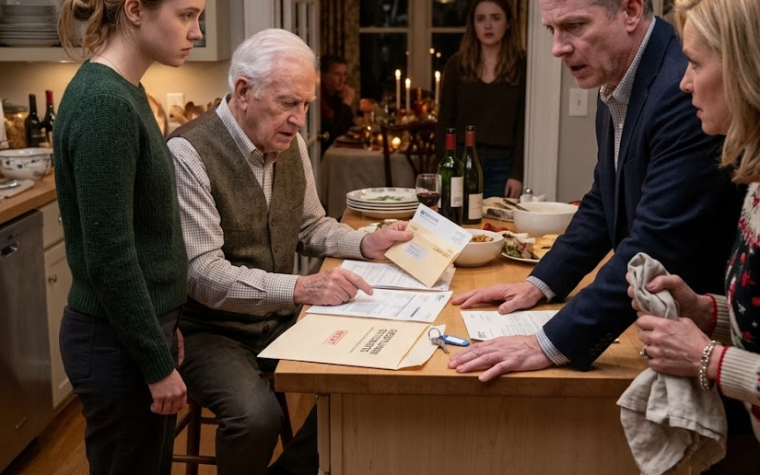
“Just a second,” Judge Whitmore said, looking from the document to me.
“You’re JAG?”
The question hung over the courtroom.
My mother’s face tightened.
My father turned toward his attorney as if the man had failed to warn him about a trap.
I remained seated.
“Yes, Your Honor.”
Judge Whitmore adjusted his glasses and read the page again.
The document was a verified professional record identifying me as Lieutenant Colonel Alexandra Mercer, an attorney serving in the United States military’s Judge Advocate General’s Corps.
For years, my parents had assumed I held some minor government office job because that was the explanation I had allowed them to believe.
They had never asked meaningful questions.
They had never attended a promotion ceremony.
They had never met the colleagues who trusted me with complex cases, command advice, and decisions that could alter military careers.
Now their lawyer was asking a court to declare me mentally unfit while my service record sat beneath the judge’s hand.
Judge Whitmore looked toward my parents’ attorney.
“Counsel, were you aware of the respondent’s occupation?”
The attorney cleared his throat.
“We understood that she worked in a legal capacity.”
“In a legal capacity,” the judge repeated.
His tone made the phrase sound painfully inadequate.
My mother leaned toward the lawyer and whispered sharply, “She never told us that.”
Judge Whitmore heard her.
He looked at Patricia.
“Mrs.
Mercer, your petition represents that your daughter has no stable employment history and lacks the judgment required to manage substantial assets.
Is that your sworn position?”
My mother hesitated for the first time that morning.
“She hides things,” she said.
“That is the point.
A normal daughter would tell her parents what she does.”
I felt the old pressure behind my ribs—the familiar urge to explain myself until she approved of the explanation.
I let it pass.
Judge Whitmore turned to me.
“Lieutenant Colonel Mercer, why was your professional history not known to your parents?”
“My work was not a secret from the government, my command, my grandmother, or anyone with a legitimate need to know,” I said.
“I kept it private from my parents because they had a history of dismissing my accomplishments when they could not benefit from them and exploiting them when they could.”
My father pushed back from the table.
“That is ridiculous.”
His attorney grabbed his sleeve, but Michael continued.
“We paid for her education.”
“No,” I said calmly.
“Grandma Evelyn helped with my undergraduate tuition.
I paid for law school through scholarships, loans, and military service.”
The judge glanced at the estate file.
“There appears to be documentation supporting that.”
My father stared at me.
That was the first crack in his certainty.
My attorney, Daniel Cho, rose.
“Your Honor, the petitioners have made serious accusations concerning capacity, coercion, and my client’s mental fitness.
We are prepared to address each one.
We also have evidence showing that the petitioners knew very little about Evelyn Mercer’s life during the final eight years before her death.”
Patricia gave a small, offended gasp.
“We called her.”
Daniel opened the first folder.
“According to telephone records, Mrs.
Mercer, you called your mother eleven times in those eight years.