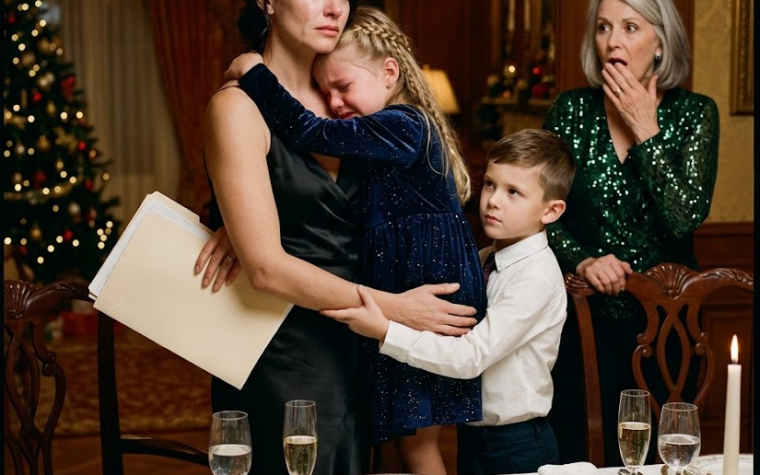
Mom looked around the room as if searching for someone willing to rescue her.
Nobody moved.
The guests had become a jury without being asked.
Not a legal jury.
Something worse for a woman obsessed with appearances.
They had seen the evidence before she could rewrite the story.
My father whispered, “We are not signing anything in front of these people.”
Grandma nodded toward a side room off the ballroom.
“Then sign it in there.”
For several seconds, he stared at her.
Then he looked at Mom.
For the first time that day, the two of them looked small.
They went into the side room with the envelope.
Brandon remained at the head table.
Melissa did not sit beside him again.
The reception never recovered its polished rhythm.
The music resumed eventually, but conversations stayed low.
People ate because plates had already been served.
The champagne fountain kept running because machines do not care whether a family has just collapsed around them.
I found that strangely comforting.
The world had not ended.
Only a lie had.
Twenty minutes later, my parents came back out.
Mom’s eyes were red, but her posture was rigid.
Dad handed the envelope to Grandma.
“They signed,” she told me quietly.
Mom heard her.
“Are you happy now?”
I looked at her for a long moment.
“No.”
That seemed to confuse her.
She had always treated conflict as a contest.
Somebody had to win.
Somebody had to lose.
But I had not wanted a public victory.
I had wanted to go to college with the money my grandparents had saved for me.
I had wanted my mother to care that taking it frightened me.
I had wanted my father to look up from his phone before her hand hit my face.
No document could give me those things.
“I’m not happy,” I said.
“I just don’t have to pretend anymore.”
She looked away first.
The months after the wedding were less dramatic and more difficult.
There was no magical check for $156,000 the next morning.
There were statements, meetings, repayment schedules, and uncomfortable conversations with attorneys and the bank.
My parents had to sell things they had purchased to maintain an image they could not afford.
Other expenses were cut.
Money began returning in installments under the agreement Grandma had insisted they sign.
Grandma also made sure my education plans no longer depended on my parents controlling the account.
My scholarships covered part of the cost, just as Brandon had mocked me for knowing they would.
But for the first time, scholarships felt like what they were supposed to be: recognition of my work, not an excuse for somebody else to steal what had been saved for me.
Brandon blamed me for months.
At first his messages were angry.
Then defensive.
Then strangely casual, as if enough time should erase what happened.
I stopped arguing with him.