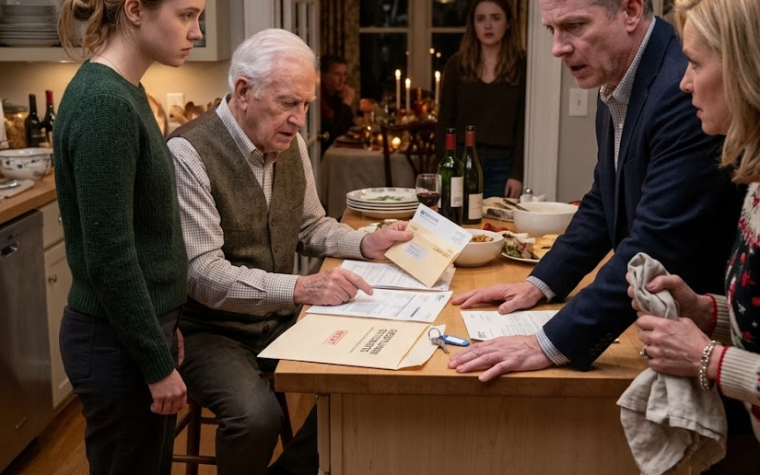
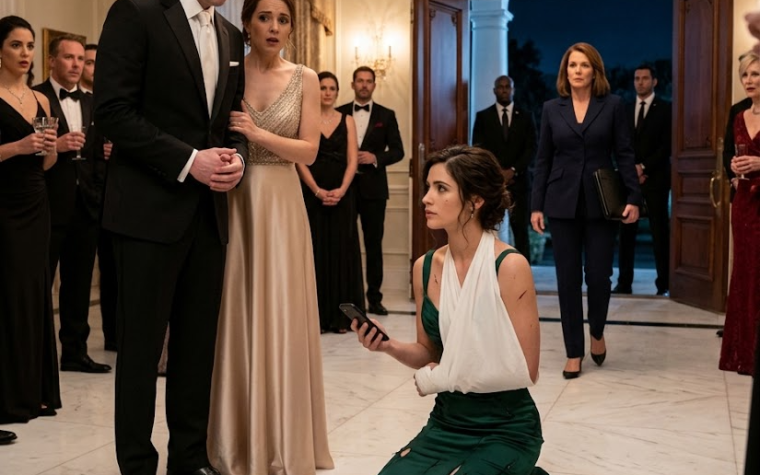
The detective blocked him.
Samuel looked wounded.
“Please,” he said.
“We can fix this.”
I thought of the recording.
I thought of him stepping over my body to wipe oil from his shoe.
I thought of the ease with which he had told the doctor I was unstable.
“No,” I said.
One word ended what three years of explanations never could.
The detectives did not arrest Samuel merely because he had been a terrible husband.
They acted on the evidence: the coordinated cover story, the attempt to conceal the recording, the financial transactions, the threats, and his conduct while I lay injured on the floor.
He was removed from the hospital while investigators reviewed the archive and secured the house.
Before leaving, he looked back at me.
For the first time since our wedding, he seemed to understand that I existed separately from him.
He looked terrified by the idea.
The days that followed were not easy.
I underwent repeated treatment for the burns.
Dr.
Stone warned me that healing would be slow and that some scars would remain.
A hospital advocate helped ensure that neither Samuel nor Joyce could contact me.
The evidence supported emergency protective orders, and the trust documents established that the house and protected assets had never belonged to Samuel.
Investigators recovered additional records from the home.
They found copies of statements Samuel had hidden, notes Joyce kept about my schedule, and messages in which they discussed portraying me as mentally incompetent if I ever challenged the transfers.
The cloud archive showed that Samuel had repeatedly attempted to access accounts he had no legal authority to control.
It also proved that he had lied about disabling the cameras.
He had disconnected the local recorder, but the encrypted backup continued uploading beyond his reach.
As the case moved forward, Samuel and Joyce continued blaming each other.
Joyce claimed Samuel had manipulated her into believing I was dangerous.
Samuel claimed years of loyalty to his mother had clouded his judgment.
The footage showed something simpler: both of them knew exactly what they were doing until they realized they might be held responsible.
The criminal proceedings addressed the assault, the coordinated deception, the concealment attempts, and the financial evidence.
Joyce was convicted for the deliberate attack.
Samuel faced consequences for his role in the cover story, the abuse, and the attempts to control property that was never his.
The civil process returned what little he had managed to divert and permanently barred both of them from my home and accounts.
Our divorce did not require a dramatic courtroom speech.
The documents spoke more clearly than Samuel ever had.
He had signed acknowledgments confirming the trust terms.
He had no ownership claim to the house.
His messages established intent.
His own voice on the recordings dismantled every version of events he tried to invent.
When the final order was entered, he stared at me across the room as though he still expected me to rescue him from the consequences.
I did not.
Months later, I returned to the house.
The kitchen had been professionally cleaned, but I could still identify the exact place where I had fallen.
For several minutes, I stood in the doorway unable to cross the tile.
Then I noticed the camera above the cabinet.
Its small indicator light was steady.
That camera had not saved me from being hurt.
Evidence could not reverse the oil, erase the scars, or return the years I spent doubting my own memory.
But it had protected the truth when I was too injured to speak.
I crossed the kitchen slowly and opened the cabinet where Joyce had kept the steel pot.
The shelf was empty.
The detectives had taken it as evidence.
For the first time, the emptiness felt comforting.
I changed the locks.
I restored my accounts.