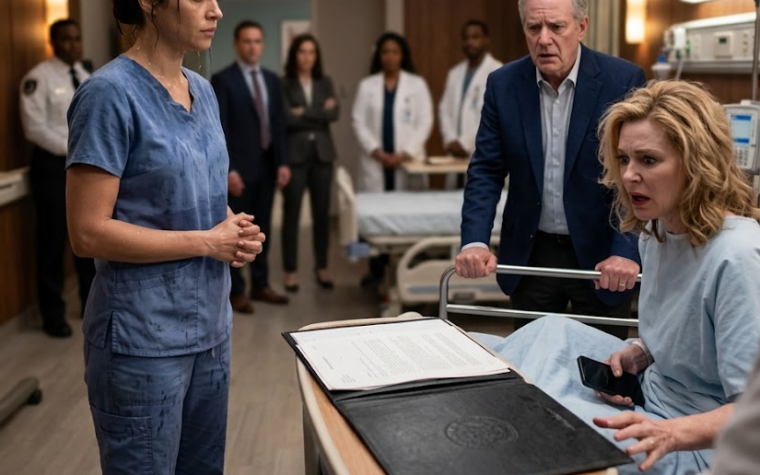
The first page inside Mara’s folder carried my mother’s full legal name.
Beneath it was a detailed record of every demand she had made, every message she had sent and every threat she had used to force me to surrender the money reserved for my daughter’s surgery.
My mother stared at the page, then at Mara.
“What is that?” she demanded.
Mara did not answer her.
She looked at me instead.
“Did she strike you?”
Another contraction tightened across my abdomen before I could speak.
I nodded and pointed toward my phone on the bedside table.
“It’s recording.”
My mother lunged for it.
The security officer stepped between us.
“Do not touch anything,” he said.
My father finally released the bedrail.
His eyes darted from the phone to the open folder as if he were searching for a version of the situation that did not implicate him.
“She is emotional,” he said.
“Her mother barely touched her.”
Mara turned toward him.
“The fetal monitor alarmed immediately after the contact.
Her water broke.
You were present, and the recording will establish what everyone said.”
My mother lifted her chin.
“She is unstable.
She has been unstable since her husband died.”
That sentence had terrified me for a month.
Hearing it now, with Mara standing beside me, it sounded different.
It did not sound like authority.
It sounded like evidence.
The nurse rushed into the room, followed by two members of the delivery team.
She took one look at the monitor and pressed the emergency call button.
“We need to move now.”
My mother tried to follow as they unlocked the bed.
“I’m her mother.”
The nurse blocked her path.
“The patient has restricted your access.”
“She cannot do that.”
“She already did.”
My father’s mouth fell open.
Mara removed another document from the folder.
“This hospital received her visitor restrictions, medical authorization and emergency guardianship instructions three days ago.
Neither of you has decision-making authority.”
Mom’s expression twisted.
“She is carrying my granddaughter.”
“No,” I said through another wave of pain.
“I am carrying my daughter.”
The distinction silenced the room.
The nurses pushed my bed toward the hallway.
As we passed my parents, my mother reached for my arm.
Security caught her wrist before she touched me.
She began shouting that I was mentally ill, that I was being manipulated and that the hospital would be responsible when I harmed my own child.
Mara walked beside my bed without looking back.
“Keep breathing,” she told me.
“Everything she says is being documented.”
The operating room lights blurred above me as the team moved quickly.
A doctor explained that the baby was in distress and that waiting was no longer safe.
My daughter had already been expected to need immediate cardiac care.