Taylor did not get the money.
Whatever consequences she faced from the choices that created her emergency remained hers to face.
Kevin could not fix that with a phone call, and my mother could not fix it by frightening me into obedience.
Their greatest loss was not financial.
It was access.
For years, they had assumed they could hurt me and still walk back into my life whenever they wanted.
After Room 418, that ended.
I blocked their numbers.
I stopped answering messages passed through old channels.
I made it clear to the hospital, my bank, and anyone involved in my daughter’s care that my parents, Taylor, and Kevin had no authority to make decisions for us.
I also kept every message connected to that day.
Not because I wanted revenge.
Because I had finally learned that forgetting was one of the ways I had kept myself trapped.
Every time they hurt me, I softened the memory afterward.
I changed cruelty into stress.
Neglect into awkwardness.
Entitlement into need.
That was how I had spent years telling myself my family was flawed, not cruel.
Room 418 took that story away from me.
Months later, after my daughter was home and the rhythm of our life had finally become something other than hospitals and fear, I found the folder again.
The corners were bent.
Several pages had been pulled out and returned so many times that they no longer sat neatly together.
On top was the medical estimate that had once terrified me.
Under it were the records of Jason’s truck sale, the settlement balance, my bookkeeping deposits, and the contributions from the men who had worked beside him.
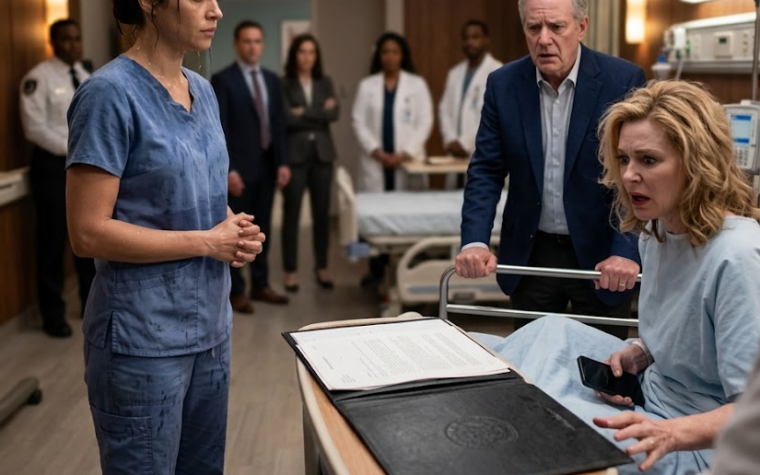
I thought about my mother standing over my hospital bed demanding that money.
Then I thought about Jason’s mother placing the same folder between us.
That was the moment the power shifted.
Not because the folder contained some magical document that could punish my family.
It contained something more important.
Proof.
Proof that I had survived Jason’s death without their help.
Proof that the money belonged to the future I was trying to protect.
Proof that my daughter’s needs were real, no matter how inconvenient they were to Taylor.
And proof that when my family finally pushed me past the point where excuses could survive, I was capable of saying no and letting the consequences fall where they belonged.
I used to think keeping a family together meant absorbing whatever damage they caused.
I know better now.
The day my mother struck me, she believed pain would make me surrender.
Instead, it ended the one thing that had protected her for years: my willingness to pretend she hadn’t meant to hurt me.
My daughter kept her medical fund.
She received the care it had been built to provide.
My parents left the hospital without the money they came for, and without the daughter they believed they could control forever.
And when I finally carried my baby home, Jason’s mother walked beside us.
For the first time since my husband died, I did not feel like the person who had been abandoned.
I felt like the person who had chosen what remained.