Evelyn immediately used that visit as proof that she had been right.
She left three voicemails.
In the first, she said the authorities were involved because Nora had serious problems.
In the second, she said I was destroying the family over one stressful afternoon.
In the third, she cried and asked how I could punish my own mother for trying to help.
I saved every message.
Rachel sent texts claiming the footage had been misunderstood.
Then she wrote that I had no right to record private conversations in my own home.
Finally, she threatened to tell relatives that I had abandoned Nora to attend a conference and returned only after the situation became dangerous.
I saved those messages too.
The child-services worker visited two days later.
She spoke gently with Nora, inspected the house, reviewed the recordings, and asked about my travel arrangements.
I showed her the conference schedule, my original return ticket, the changed flight, and the messages confirming that Evelyn and Rachel had volunteered to stay with Nora.
The worker closed her notebook.
“Your daughter did not create the dangerous situation shown in the report,” she said.
“The adults who staged it did.”
For the first time since coming home, I took a full breath.
She recommended that Nora have no unsupervised contact with either woman while the matter was reviewed.
She also documented Nora’s fear that police would remove her.
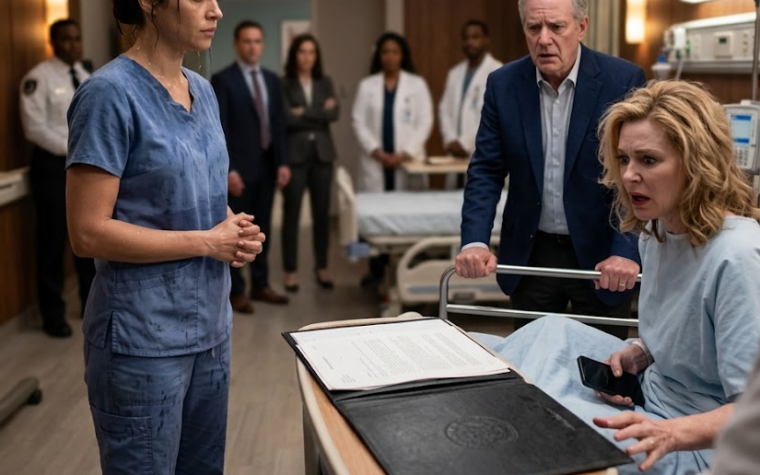
The following Monday, one week after I found Nora on the rug, I attended a hearing for a temporary protective order.
Evelyn arrived dressed as though she were attending church.
Rachel carried a thick folder and kept whispering to her.
They had brought printed photographs of Nora’s toys scattered across my living room, carefully cropped so the women moving those objects were nowhere in view.
Their attorney argued that the incident was an unfortunate family disagreement exaggerated by a security system that captured only fragments.
Then Officer Morales testified.
He described the original report, the condition of the room, Nora’s statements, and the moment the full recordings contradicted every significant claim Evelyn and Rachel had made.
The unedited video played in court.
This time, my mother could not order anyone to turn it off.
The judge watched Evelyn tear Bunny’s ear.
She watched Rachel lower the lamp to the floor.
She heard them discuss creating a record against Nora and me.
She heard Evelyn threaten a five-year-old with removal before opening the door to the police.
When the video ended, Rachel stood abruptly.
“That is not what happened!”
Her own voice had just narrated what happened.
The judge ordered her to sit down.
Evelyn began crying.
She said she had been exhausted, that Nora was difficult, that I had poisoned the child against her, and that the cameras made ordinary discipline look sinister.
Then the emergency call was played.
Her performance on the recording was so polished that even she seemed startled by it.
The judge granted the temporary order.
Evelyn and Rachel were prohibited from contacting Nora directly, entering my property, visiting her school, or using relatives to pass messages to her.
The judge also noted that the evidence would remain available to investigators reviewing the false emergency report.
That was when they began screaming.
Rachel shouted that I had manipulated everyone.
Evelyn cried that I was stealing her granddaughter and destroying her life.
When they moved toward me, the bailiff stepped between us.
Nora was not in the courtroom.
She was safely at school, drawing another fox.
I did not argue with them.
I picked up my copy of the order, placed it inside my folder, and walked out while their voices echoed behind me.
The criminal review continued for several months.
Both women eventually faced consequences for knowingly making a false report.
The final penalties included fines, mandatory counseling, and restrictions that reinforced the protective order.
More damaging to them than the court requirements was the preserved record itself.
Every time they attempted to retell the incident as a misunderstanding, the unedited footage existed.