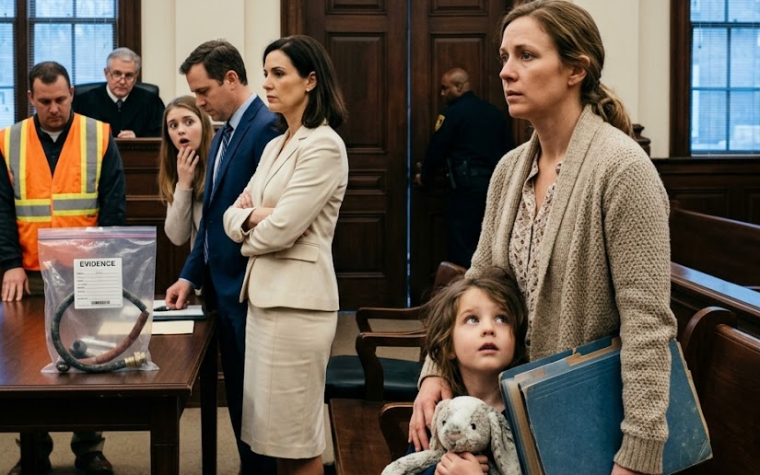
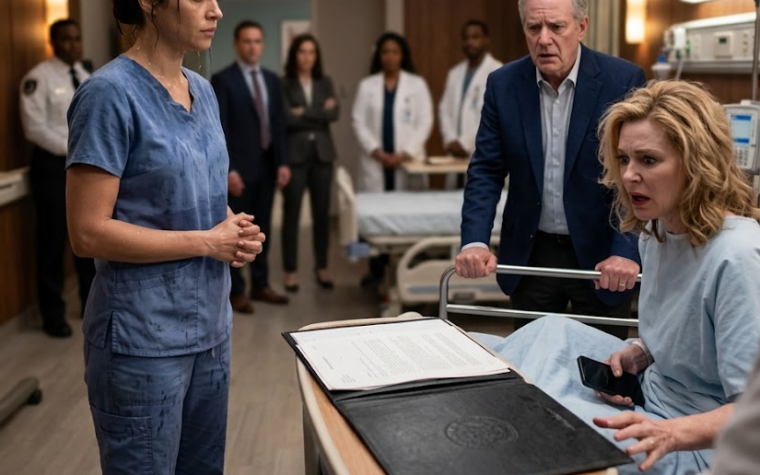
The financial investigation widened quickly, and David’s death was formally reopened.
Evidence gathered from the transfers, communications, recordings, and Sienna’s cooperation supported charges connected to the scheme against our family and the events surrounding David’s crash.
The legal process was not clean or immediate.
Nothing about real consequences was.
Garrett fought every allegation.
His attorneys attacked Sienna’s credibility and described Margaret’s recordings as the suspicions of a dying woman.
But recordings do not become less audible because the person who made them is dead, and financial trails do not become sentimental because someone wishes they would disappear.
Sienna entered the recovery program our mother had required.
For months, I didn’t know whether I would ever forgive her.
She didn’t ask me to.
That mattered.
She admitted what she had done without turning every confession into a request for comfort.
She acknowledged that Garrett had exploited her debts and dependency, but she also stopped pretending exploitation erased her own choices.
A year later, she completed the conditions attached to her inheritance.
When Harrison told me, I expected to feel resentment.
Instead I thought of my mother.
The restricted account hadn’t been punishment.
It had been the last boundary Margaret could leave behind.
As for me, I never gave Garrett authority over a dollar.
Sullivan Vineyards remained protected.
The properties remained mine.
The trust remained beyond the reach of the man who had married me expecting grief to make me easy to control.
Months after the worst of the hearings, I returned alone to the terrace where we’d held my mother’s funeral.
The vineyard rows stretched toward the hills, green now instead of October gold.
For most of my life, I’d thought my mother’s strength was certainty.
Margaret Sullivan always seemed to know what should happen next.
I understood her differently after she died.
She hadn’t known everything.
She had said so herself.
I do not know everything.
What she had done was pay attention when something felt wrong.
She documented.
She protected.
She created barriers where love might otherwise make me careless.
I carried David’s phone out to the terrace with me.
I had listened to his recordings enough times to know every breath between his sentences.
Eventually I stopped listening.
Not because they stopped mattering.
Because I finally understood that proof was supposed to release me from uncertainty, not become another room where I kept the dead alive.
I placed the phone inside a drawer in my mother’s study beside her blue-ink note.
For months, the two objects had represented betrayal.
That afternoon, they felt different.
David had tried to warn me.
My mother had finished what he couldn’t.
And when the moment came, Sienna had finally told the truth before Garrett could take one more thing from our family.
I walked outside without the phone.
The vineyard crew was finishing for the evening in the distance.
Somewhere below, a door closed.
Wind moved through the vines with a dry whisper.
For the first time since David’s crash, I didn’t turn toward the sound expecting another disaster.
Garrett had believed my trust was my weakness.
My mother understood something he never did.
Trust could be withdrawn.
Evidence could survive grief.
And love, when it was real, did not ask me to sign away my judgment in order to prove it.
I stood on the terrace until the light disappeared behind the hills, not as Margaret Sullivan’s frightened daughter, not as David’s grieving widow, and not as Garrett’s wealthy wife.