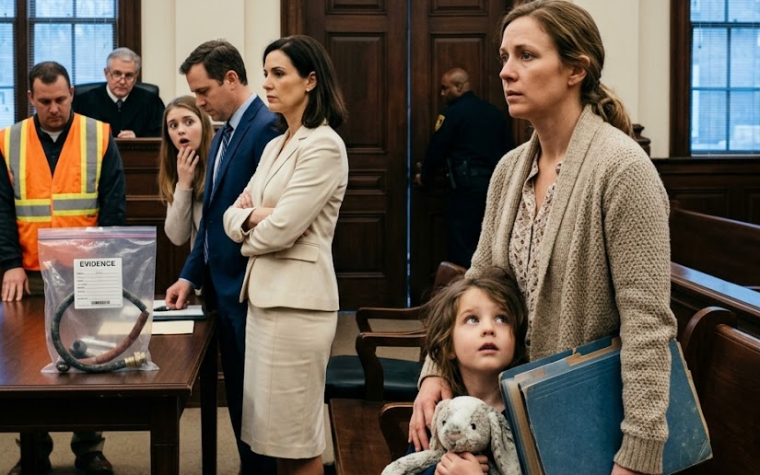
It had been withdrawn from an operating account belonging to the company Andrew and I jointly owned.
They had used my own money to pay me to disappear.
The blue-folder documents would transfer my ownership interest to Andrew after I supposedly admitted abandoning the marriage.
A separate affidavit claimed I had become emotionally unstable and had threatened to vanish with an unnamed lover.
The death certificate appeared to be a professionally prepared counterfeit designed to receive a seal later.
The itinerary showed that a private driver had been scheduled to meet me after my supposed arrival in Paris.
Attached to it was a payment confirmation routed through a small consulting company.
Beside the confirmation, Andrew had written a telephone number and three words:
Second phone only.
At the police station, an investigator took the bag without touching the papers directly.
She listened to the recording twice, then asked the housekeeper to repeat exactly how she had found the documents.
The housekeeper explained that Andrew had been unusually secretive for several weeks.
He had ordered her not to enter his office, then suddenly instructed her to clear the bins before the celebration.
She had noticed my name on the death certificate as she tied the trash bag.
Instead of carrying it outside, she hid it in the laundry room and waited until she could leave through the garden.
“You saved my life,” I told her.
She shook her head.
“I almost threw it away.”
My attorney arrived shortly before midnight.
He reviewed the property transfers and immediately recognized my supposed signature.
It had been copied from a deed I signed three years earlier.
“The curve on the V is identical,” he said.
“So is the ink break after the final letter.
No one signs their name in precisely the same pattern twice.”
He contacted the bank’s emergency fraud department and placed a legal hold on any transfer involving my company interest.
He also prepared a request for a temporary injunction preventing Andrew from filing or selling anything in my name.
The investigator had a different concern.
“Who knew your original travel plans?” she asked.
“Andrew and Eleanor.”
“Did either of them arrange anything after your arrival?”
I remembered Eleanor insisting that I accept her help booking transportation.
“She sent me a message saying a private driver would meet me in Paris.
I thought it was part of the gift.”
I opened the message.
There was no company name, only a description of the car and a promise that the driver would know my name.
The investigator copied it.
“What happened when you canceled the flight?”
“I received three missed calls from an unfamiliar international number.
I ignored them.”
The number matched the one written beside the itinerary.
By two in the morning, the police had requested emergency records for the payment account and the second phone.
My attorney had sent fraud notices to the county clerk, the company’s bank, and every officer authorized to approve ownership changes.
For the first time that night, I allowed myself to breathe.
Then my phone lit up.
Andrew was calling.
The investigator gestured for me to answer and placed a recorder beside the phone.
I forced my voice to sound sleepy.
“Hello?”
“Where are you?” Andrew asked.
The question came too quickly.
“At the hotel.”
“What hotel?”
I paused.
“You know which hotel.
Your mother booked it.”
Silence.