Arthur attacked Ray’s hearing, his age, his finances, and his memory.
Each attack created another headline.
Each headline brought forward another witness.
A retired Cross Meridian secretary produced letters Arthur had ordered her to destroy in the 1980s.
A former security employee admitted he had monitored Ray’s garage.
An insurance investigator reopened the old fire report after finding signs of deliberate ignition.
The man who had built his power through silence discovered that silence could end all at once.
Derek’s lawyers tried a different strategy.
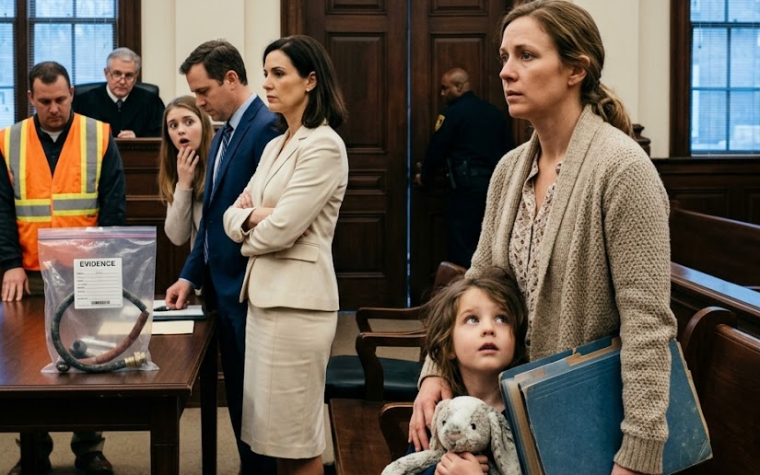
They petitioned for emergency custody of Lily, claiming I was unstable and that Ray had created a dangerous confrontation in the hospital.
Arthur offered the court a guesthouse on his estate, private nurses, and round-the-clock security for the baby.
My attorney played the rabbit video.
The courtroom heard Derek say, The child is mine.
It heard Arthur say that fear prevented disobedience.
It saw Ray block Derek without throwing a single blow.
The judge denied the Cross family’s petition and issued a temporary protective order.
I received sole physical custody while the criminal case proceeded.
Derek was prohibited from contacting me directly.
Outside the courtroom, reporters shouted questions at Arthur.
He ignored them until one asked whether Sergeant Keene had invented the technology that made him rich.
Arthur stopped walking.
For one second, his old expression returned—the cold confidence of a man who expected the world to move aside.
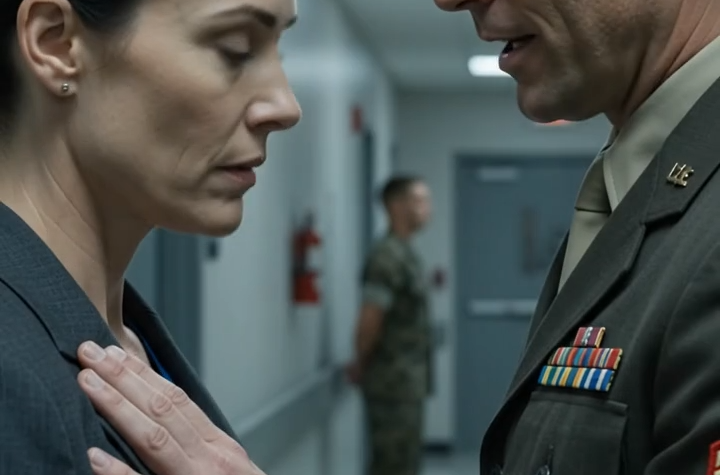
Then Ray stepped out of the courthouse behind me.
Arthur saw the brass lighter in his hand and lowered his eyes.
Derek eventually turned on his father.
Faced with the hospital recording, medical evidence, and the possibility of prison, he told investigators that Arthur had encouraged him to control me before Lily’s birth.
He produced messages in which Arthur described a wife and child as “leverage” and warned that weakness inside a family could threaten the company.
Derek claimed he had only followed the example he had been given.
It did not excuse him.
He pleaded guilty to assault and accepted a long-term no-contact order.
Family court later required supervised visitation, conditioned on treatment and continued compliance.
He lost his executive position and the trust distributions Arthur had used to keep him dependent.
Arthur faced consequences on a larger scale.
A federal grand jury indicted him on fraud, obstruction, and witness-tampering charges connected to the company’s founding records and later concealment.
Cross Meridian’s board removed him permanently.
The company entered a settlement with Sergeant Keene’s surviving family and created an independent restitution fund for veterans whose work had been used without credit.
Arthur’s lawyers fought every allegation.
He sold properties, blamed advisers, and insisted that history was being rewritten by opportunists.
But the history had been written long ago in a black notebook.
Ray refused every interview request that offered money.
When the board proposed naming a research building after him, he declined.
“Keene designed it,” he said.
“Put his name on the wall.”
He accepted only reimbursement for the years he had spent preserving the archive.
Most of it went into a trust for Lily and a fund supporting hearing care for veterans.
Months after the hospital, Arthur requested a private meeting with Ray.
Ray agreed to meet in a courthouse conference room with attorneys present.
Arthur arrived without his usual entourage.
He looked older, his expensive suit hanging loosely from his shoulders.
“What do you want from me?” he asked.
Ray placed the Zippo on the table.
“Nothing you own.”
“There must be something.”
“I wanted you unable to buy her silence.”
Arthur stared at the lighter.
“I was nineteen,” he said.
“I was afraid.”