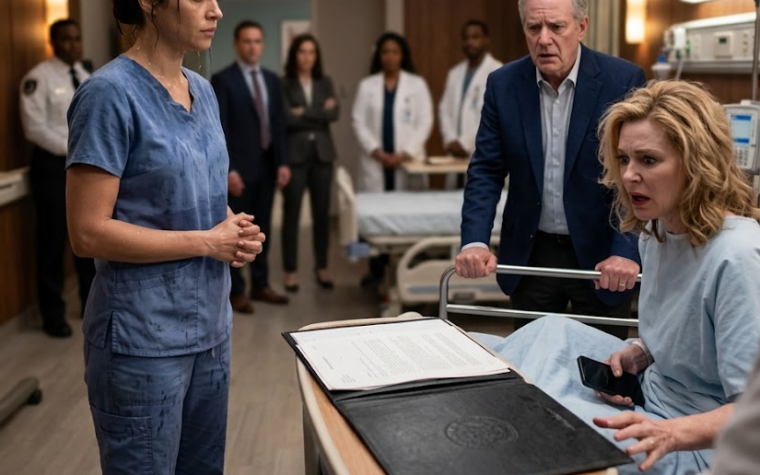
The CFO asked for the underlying contracts.
Grant said Vanessa had them.
Vanessa said finance had them.
Finance records showed no complete contracts attached.
Then Ruth displayed the metadata from the emergency delegation.
Created four days before my collapse.
Modified twice the morning of the champagne toast.
Grant leaned toward his camera.
“My attorney prepares contingency documents all the time.”
Ruth asked calmly, “Which attorney prepared this one?”
He paused.
“No answer?” she asked.
“This is ridiculous.”
The board chair said, “Grant, answer the question.”
He named no attorney.
Vanessa looked down.
The pressure shifted visibly between them.
For months they had operated as a team because each believed the other would protect the plan.
Now every question made protection more expensive.
The board chair turned to Vanessa.
“Who gave you the emergency authorization?”
Vanessa hesitated.
Grant answered for her.
“I did.”
Ruth said, “Thank you.”
Grant realized again that he had spoken too quickly.
The board chair asked why Vanessa, a secretary without corporate governance authority, had been assigned to circulate a document transferring executive power.
Grant said she was merely assisting him.
Then the CFO produced system logs showing Vanessa had attempted to upload the authorization packet before I regained consciousness.
Her face drained of color.
“That was at Grant’s instruction,” she said immediately.
Grant turned toward her.
“Vanessa.”
“You told me to send it.”
“I told you to prepare it.”
“You said the board needed it before morning.”
“Stop talking.”
The board heard that clearly.
So did I.
Vanessa stared at him as if something between them had finally cracked.
Ruth said nothing.
She did not need to.
People reveal extraordinary things when silence gives them room.
Vanessa began defending herself.
She said Grant had assured her the authorization was legal.
She said he told her I had already agreed in principle to let him assume temporary control if my health became unstable.
She admitted knowing the document had been prepared before the party, but claimed she believed it was ordinary succession planning.
Then the board chair asked the question that destroyed that explanation.
“If you believed this was ordinary planning, why did you ask whether Evelyn had ‘taken it’?”
Vanessa went completely still.
Grant looked at her.
Then at me.
The sentence had not come from a recording.
It had come from me.
That distinction mattered legally, but it mattered differently inside that room.
They knew I had heard them.