He claimed the headstone was only a memorial created during a period when everyone believed she had died.
The deputy asked for the death certificate.
Daniel had none.
That evening, child services arranged for Emily to remain temporarily at the trailer while the court reviewed the documents.
I wanted to take her home immediately, but I understood why strangers needed to confirm that the woman Daniel had described as dangerous was safe.
I slept in a chair beside the trailer’s front door.
Emily slept in the back bedroom with Captain Bun tucked beneath her chin.
At three in the morning, she came into the hallway and stared at me.
“You’re still here,” she said.
“I’m still here.”
“Will you be here when I wake up?”
“Yes.”
She returned to bed without touching me, but she left the door open.
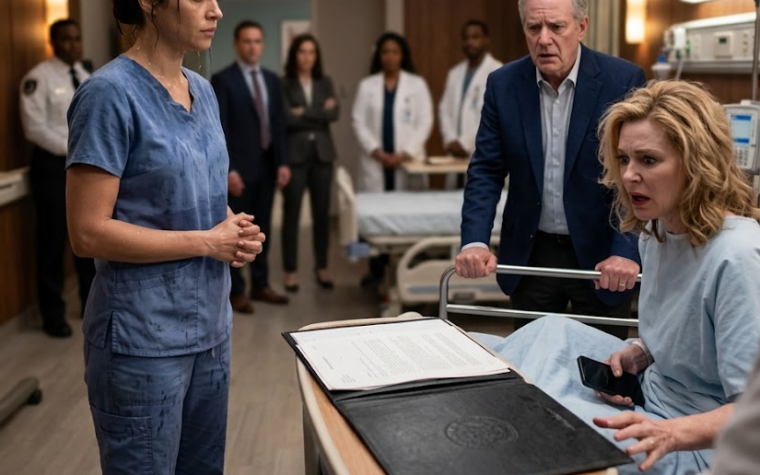
The emergency hearing took place the next morning.
My attorney brought my travel orders, passport stamps, phone records, and every unanswered request for Emily’s medical and death documents.
The Knoxville hospital confirmed that no child matching Emily’s identity had been admitted on the date Daniel claimed she died.
The county had no death certificate.
Maple Ridge Cemetery had no burial permit, no funeral-home authorization, and no record of remains placed beneath the stone.
Daniel had purchased only a marker.
The old oak section contained an empty patch of earth with my daughter’s name carved above it.
Investigators searched Daniel’s phone and recovered messages he had exchanged with his mother.
One instructed her to remove Emily’s bicycle, rain boots, and half the clothes from the bedroom before I returned.
Another said, “Keep Rachel focused on the funeral.
If she believes Emily is gone, custody disappears.”
The final message had been sent on the morning of my flight home.
“Once the divorce is finished, we can move her and start over.”
That was the motive stripped of every excuse.
Daniel had resented my overseas work and feared that I would leave him when I discovered how much of our money he had hidden and how often he lied.
He believed a custody fight would expose him.
So he created a loss too enormous for me to question and counted on grief to make me obedient.
He told me Emily was dead.
He told Emily I had abandoned her.
He told her caregiver I was dangerous.
He gave each of us a different lie and placed distance between us so the lies would never meet.
Caleb destroyed the entire plan by recognizing one photograph.
During a recorded child interview, Emily described the motel, the late-night drive, and waking in the trailer while Daniel told her I had chosen my job over her.
She remembered the motel ice machine and the paper cup of orange juice that appeared on the receipt as a child’s breakfast.
She remembered asking to call me.
Daniel first said my phone was broken.
Then he said I did not want to speak with her.
Months later, he said I had died overseas and that asking about me upset everyone.
When she refused to answer to Emma, he threatened to send her somewhere Caleb and his grandmother could never visit.
The judge granted me temporary sole custody with no contact from Daniel while the criminal investigation continued.
The first exchange happened in a courthouse family room under the supervision of a therapist.
Emily sat across from me twisting Captain Bun’s ear.
I did not ask her to call me Mom.
I did not tell her how many Sundays I had spent beside the stone.
I answered only what she asked.
“Did you stop loving me?”
“No.”
“Did you believe I was dead?”
“Yes.”
“Why didn’t you dig up the grave?”
That question stayed in the room for a long time.
“Because I trusted people who were supposed to love us,” I said.
“And because grief can make a lie feel too painful to touch.”