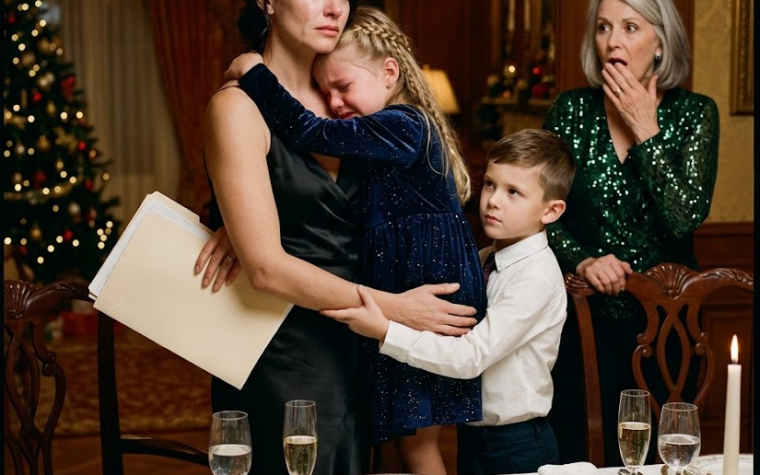
“Because she never erased you from his story.”
That sentence hurt in a way accusation never could.
Jonathan removed the old photograph from the envelope and placed it between us.
It showed a younger woman sitting on a park bench with Finn on her lap.
He looked about two.
Mara was laughing at something outside the frame while Finn held both hands against her cheeks.
Nothing about the photograph suggested neglect or misery.
He had been loved.
That should have comforted me.
Instead it made me cry.
Not because I wanted to replace her.
Because for four years, somewhere in the world, the son I had wondered about every birthday had been growing up inside another woman’s arms—and that woman had apparently thought enough about me to make sure I could be found if he ever needed someone.
“Why did you bring him here?” I whispered.
Jonathan reached into the envelope again.
There was a letter from the adoption agency confirming the original placement, a copy of Mara’s emergency guardianship nomination, and paperwork from the hospital social worker documenting Finn’s temporary release for the night while the court and child services reviewed the situation.
The nomination did not magically make me his legal mother again.
My parental rights had ended with the adoption.
Mara had understood that.
The document simply asked that, if she died without another legal parent available, authorities consider placing Finn with me if I was willing and if the court found it appropriate.
I looked at Jonathan.
“You knew she had done this?”
“No.”
“You expect me to believe you learned all of this in one night?”
Pain crossed his face.
“I expected you to ask me before deciding I’d spent four years cheating on you.”
I looked away.
He deserved that answer.
But another thought struck me.
“How did they even reach you?”
“The agency had your updated contact information from the file.
You kept your address current when we moved, remember?”
I did.
Years earlier, I had completed a form saying I was open to receiving contact if my son ever needed medical information.
I had told myself it was responsible paperwork, nothing more.
Jonathan continued.
“They called your number first.
Your phone was upstairs charging.
Then they used the secondary household contact.
Me.
I was already in the hospital.”
He showed me the call record, then immediately put his phone facedown.
“The hospital social worker explained what had happened.
Finn had nowhere safe to go tonight.
They asked whether we could take him temporarily while the legal process started in the morning.”
“And you said yes without me.”
“Yes.”
The anger inside me found something solid again.
“You had no right.”
“Maybe not.”
“Maybe?”
His voice remained quiet.
“I had a four-year-old boy sitting in a hospital room after watching the only mother he remembers disappear behind an emergency-room door.
He was asking whether he was going to sleep alone.
I knew who he was.
I knew who you were.
So yes, Rebecca.