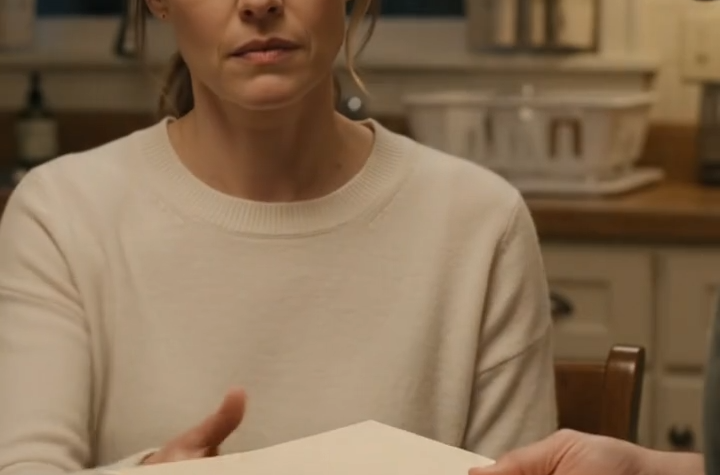
I looked at him.
“Are you hoping I do?”
“No.”
It was the first completely unguarded answer he had given me.
I signed.
Within an hour, Marco placed a stamped debt-release document in front of my father.
“It’s finished,” he said.
Robert stared at the paper.
“No more interest?”
“No debt.”
“No one will come after me?”
“No one acting under my authority.”
My father started crying.
I didn’t hug him.
That was the first consequence he had not been able to calculate away.
The first weeks of my marriage felt less like a romance than an extremely well-managed hostage situation in which the hostage had negotiated excellent terms.
Marco gave me a room on the opposite side of the house.
He never entered without permission.
I attended classes online, spoke to professors in Philadelphia at absurd hours, and learned which parts of the enormous Roman house were private and which were used for business.
We ate dinner together only when necessary.
At first, those dinners were almost silent.
Marco read financial reports.
I studied.
One night I looked up from a textbook and said, “Do you always bring work to dinner?”
He looked at my laptop.
“Do you?”
“I asked first.”
“And I answered second.”
“That isn’t how answers work.”
A faint smile appeared.
It vanished so quickly I wondered if I had imagined it.
The marriage required occasional public appearances.
Nothing elaborate.
A dinner.
A formal meeting.
Photographs taken from enough distance that the expressions mattered more than the details.
Marco would offer his arm.
I would take it.
The moment we were alone again, we separated.
He never asked for more.
That should have made it easy.
Instead, his restraint became harder to ignore.
He remembered that I hated coffee after noon because it kept me awake.
When an online exam conflicted with a scheduled appearance, he canceled the appearance without telling me until afterward.
When my laptop died in the middle of a paper, a new one appeared outside my door—still sealed, with no note and no expectation attached.
I confronted him anyway.
“You can’t keep buying solutions.”
He looked genuinely confused.
“Your computer broke.”
“I know.”
“You needed another one.”
“I know.”
“Then what are we arguing about?”
I stared at him.
“You really don’t understand normal people, do you?”
“No,” he said.