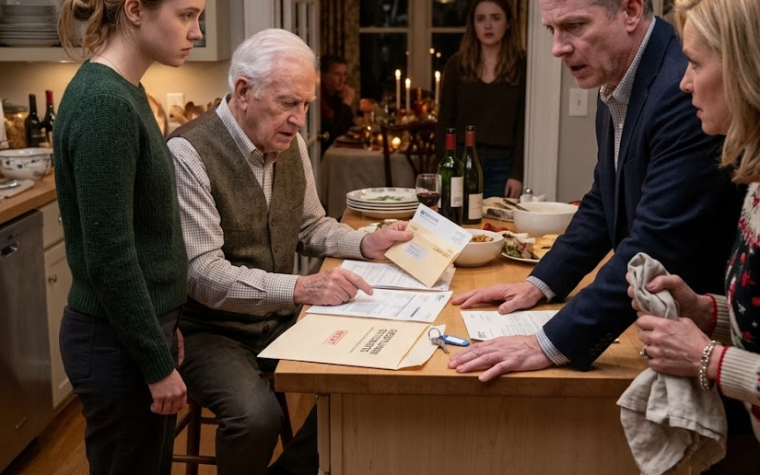
“What about me?”
Mom didn’t answer.
I continued.
“I worked all day, came home, paid bills, bought groceries when you asked, and then sat at Christmas dinner while Dad called me a burden.
You laughed.”
“I didn’t laugh at you.”
“You laughed.”
“I was uncomfortable.”
“So was I.”
Another long silence.
Then Mom said, very quietly, “I should have stopped him.”
It was not an apology.
But it was the first honest sentence I had heard from her in a long time.
“Yes,” I said.
“You should have.”
I didn’t rescue her from the silence that followed.
Over the next two weeks, the house began showing my parents what I had been protecting them from.
Not catastrophe.
Bills.
Ordinary, boring, relentless bills.
The internet required a payment method.
The gas balance had a due date.
The electric account did not care that Harold was angry.
The grocery store did not accept family obligation as currency.
Tyler told me Mom started writing every expense in a notebook at the kitchen table.
Dad hated that notebook.
He hated being asked what he could cover.
He hated hearing actual numbers.
Most of all, I think he hated discovering that the daughter he had treated as dependent had quietly built the financial structure beneath his pride.
He called me again one evening.
This time his voice was calmer.
“Your mother showed me the payment history.”
I said nothing.
“I didn’t realize how much you were covering.”
There are sentences you imagine hearing for years, only to discover they are smaller when they finally arrive.
I looked around Marissa’s spare room, where my suitcase was still half unpacked.
“You didn’t want to realize.”
He exhaled.
“Maybe.”
That word surprised me more than an apology would have.
Then he ruined it.
“But family helps family.”
I almost smiled.
“Yes.
Family also doesn’t throw someone out at Christmas and expect her debit card to stay behind.”
He had no answer for that.
“Tyler needs stability,” he finally said.
“Then give him stability.
You’re his father.”
His voice tightened.
“You know my employment situation.”
“I do.
I’ve been financing it for three years.”
He went silent again.
I did not tell him how to fix his life.
I did not offer another month.