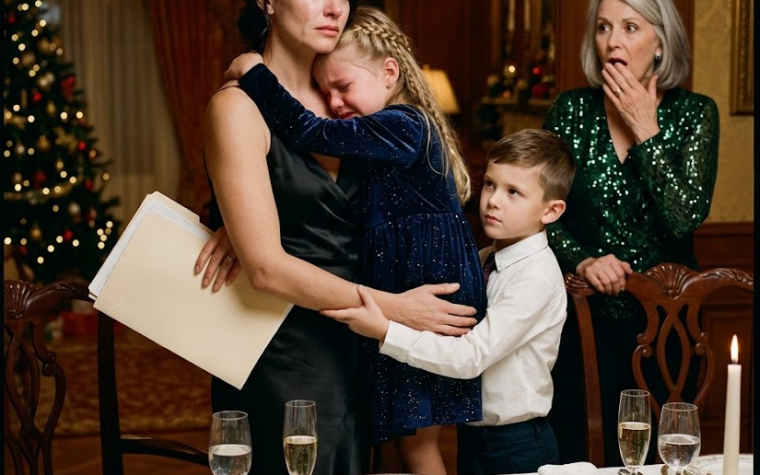
Olivia waited beside her.
When she saw me, she did not apologize.
She pointed at the apartment door.
“You could sell it and buy something smaller.”
That sentence ended whatever hope I still carried.
Even after the police, the forgery, and the exposure, she saw my home only as money she had not yet received.
“You knew they were forging my signature,” I said.
She looked away.
“Dad said it was temporary.”
“A temporary sale?”
“He said you would understand when you saw how serious things were.”
“I understood before today.”
My mother stepped closer.
Her voice softened into the familiar tone that had pulled me back into obedience countless times.
“We made mistakes.
But pressing charges will destroy this family.”
I held my grandfather’s letter against my chest.
“No.
What you did destroyed the version of the family that required me to disappear.”
She began to cry.
For once, I did not rush to comfort her.
The investigation lasted several months.
The digital trail made denial difficult.
The forged authorization had been created on my parents’ home computer.
Metadata linked the document to an account my mother used.
My father’s emails to the realtor established intent, and the locksmith’s work order proved they had planned the entry before my supposed departure.
Olivia’s messages were worse.
She had sent my father photographs of the apartment and written that buyers would pay more if they listed it furnished.
She suggested placing my personal belongings in storage and telling me afterward.
When investigators recovered those messages, she finally stopped calling the plan a misunderstanding.
My father’s attorney negotiated rather than risk a trial.
He pleaded guilty to offenses related to the forged document and attempted property fraud.
He received probation, substantial fines, mandatory restitution for the damaged lock and legal expenses, and an order prohibiting him from contacting the realtor or interfering with my property.
My mother entered a diversion agreement conditioned on admitting her role, completing community service, and having no contact with me unless I initiated it.
Olivia was not charged with creating the forgery, but her participation destroyed the last financial support my parents could offer her.
Creditors pursued her directly.
She sold the designer bags, the leased car, and much of the lifestyle she had treated as permanent.
None of that felt like victory.
For a long time, the apartment did not feel safe.
Every sound in the hallway pulled my attention toward the door.
I installed a stronger security system and changed every access code.
I also hired an attorney to send formal notices that no member of my family had permission to enter, represent me, or negotiate regarding my property.
The most important change was quieter.
I stopped explaining my boundaries.
When relatives called to say my parents had only been desperate, I asked whether desperation gave them the right to forge my name.
No one had an answer.
When an aunt suggested I could have prevented the scandal by paying Olivia’s debts, I told her she was free to pay them herself.
She never mentioned it again.
Months later, I invited Helen Ward to the apartment for coffee.
She stood by the windows my grandfather had loved and told me he had worried I would mistake endurance for kindness.
“He knew you were strong,” she said.
“He was afraid everyone else would use that strength until you had nothing left.”
I showed her the letter.
She smiled when she read the final paragraph.
“Richard wrote that after your father tried to persuade him to leave the apartment to the whole family,” she said.
I looked at her sharply.