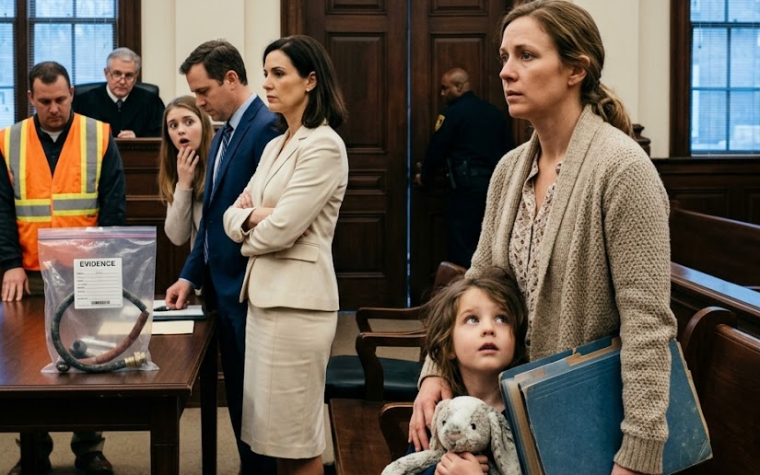
The judge asked him whether he knew about the account.
“No.”
I produced a transfer bearing a notation that corresponded to one of his obligations.
He changed his answer too.
“I knew money was moving around.
I didn’t know Olivia’s name was involved.”
My mother turned toward him slowly.
“You told me Olivia had agreed to help them.”
Dad did not look at her.
“You told me she signed papers.”
“Not now.”
“You told me—”
“Not now!”
His voice cracked through the courtroom.
The judge warned him again.
I felt something strange watching them unravel.
For years, I had imagined that exposing what they had done would feel like revenge.
It did not.
It felt administrative.
Sad, necessary, overdue administration.
I thought about the night I found Clara with Daniel.
I thought about my mother telling me to be strong because Clara was fragile.
I thought about my father saying that a good daughter would forgive.
I thought about my engagement ring, resized around my sister’s finger as though even the symbol of my future could be taken from me and reassigned by family vote.
They had trained themselves to believe that whatever belonged to Olivia could be redistributed to whoever demanded it loudly enough.
Her fiancé.
Her ring.
Her dignity.
Her money.
Now, apparently, her name.
But signatures had rules.
Banks had records.
Courts had consequences.
I handed the judge one final packet.
“This contains the complete transaction timeline and copies of the records I used to create it.
I have also identified the documents carrying signatures that I dispute as forged.”
Clara stared at the packet.
My father whispered, “Olivia, don’t do this.”
It was the first time all morning he had said my name without an insult attached to it.
I looked at him.
“Don’t do what?”
His face reddened.
“You know what this could do to the family.”
I almost laughed.
Three years earlier, when I stood in their living room watching Clara wear my engagement ring, none of them had asked what their choices would do to the family.
When they filed papers carrying my forged signature, nobody had worried about family.
When they threatened to take my wages, family had been a weapon.
Now that evidence had entered the room, family had suddenly become something sacred.
The judge spoke before I could.
“The potential consequences here are the result of the conduct reflected in these records, not Mrs.
Hartfield’s decision to present them.”
My father looked away.
Clara started crying.
Not the delicate tears my mother had produced earlier.
These were panicked, angry tears.
“You’re destroying my child’s life because you’re jealous of me,” she said.