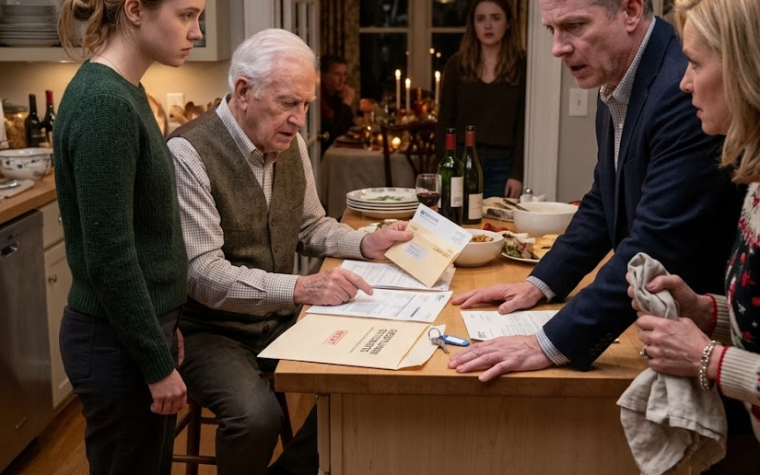
Her shoulders seemed to collapse.
“I knew there had been payments,” she said.
“I didn’t know everything.”
My father snapped, “Enough.”
But the room had already changed.
For years he had survived by controlling what each of us knew.
Now we were all standing in one place with different pieces of the same truth.
And he couldn’t separate us fast enough.
Adrian’s attorneys arrived soon afterward.
They reviewed the transfer records and confirmed what I had already found: Marcus’s movement of restricted funds had triggered a default provision.
Adrian now had the right to seize the pledged shares and take controlling interest in the company.
My father accused him of engineering the breach.
The records disproved it.
Marcus had moved the money before the wedding without Adrian’s knowledge.
Then came the older evidence.
The forged reports.
The inspector payments.
The hidden transfers.
The corporate records connecting my father’s old scheme with entities he still controlled.
Adrian did not shout when he laid those papers out.
He didn’t need to.
My father’s confidence disappeared one document at a time.
Marcus denied everything until one of his own handwritten authorizations appeared beside a matching transfer.
Then he blamed my father.
My father blamed Marcus.
Neither blamed me anymore.
By afternoon, Adrian’s legal team had secured the company records and notified the appropriate authorities and financial institutions about the evidence requiring investigation.
The process did not end that day.
Real consequences rarely arrive as neatly as revenge fantasies promise.
There were audits, interviews, attorneys, frozen accounts, and months of scrutiny.
The old waterfront fraud was reopened alongside questions about the newer financial activity.
My father lost control of the construction company under the collateral agreement.
Marcus lost access to the accounts he had treated like personal gambling funds.
Their reputation collapsed under the weight of records they had assumed no one would ever preserve.
But Adrian kept the company operating.
That surprised everyone except me.
He replaced the financial leadership, protected active payroll, and separated legitimate projects from the entities under investigation.
Employees who had done nothing wrong kept their jobs.
Contractors were paid from verified operating accounts.
He could have burned the entire structure simply because my father had once helped burn his family’s future.
He chose not to.
My mother eventually admitted she had known my father used questionable payments years earlier, though she claimed she never understood the full scheme.
I couldn’t decide for her what responsibility that carried.
I only knew what she had done to me.
For a long time, we barely spoke.
As for the marriage, Adrian gave me a choice as soon as the immediate crisis passed.
“You can leave,” he said one evening.
“No conditions.
No debt.
No obligation to me.”
We were standing in the same bridal suite where he had removed the mask weeks earlier.
The old disguise was gone.
So was the diamond necklace.
I looked at him.
“And if I stay?”
He didn’t mistake the question for forgiveness.