“I knew you used a few background moments.
You said they were indistinct.”
“They are short.”
“That isn’t what I asked.”
Her voice sharpened.
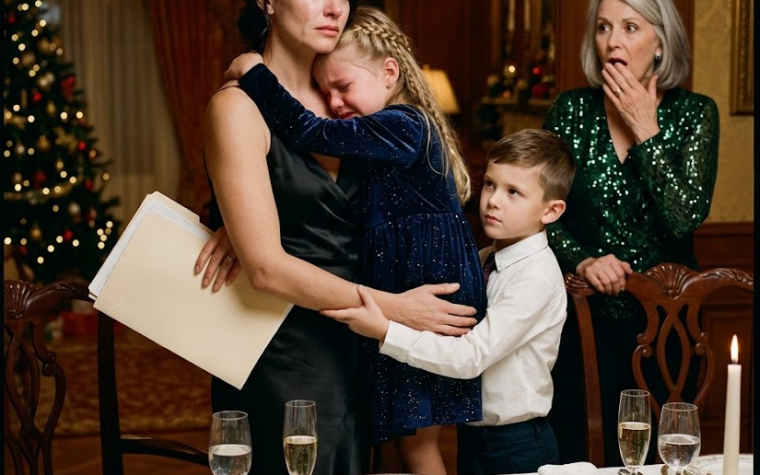
“Don’t do this in front of her.”
The words were revealing.
Even in my home, beside a forged document bearing my name, I was still being treated as an audience rather than a person.
I asked Ellis where the original dinner recordings were stored.
He rubbed a hand across his face.
“On the cloud account connected to the microphone.”
“Can you access them?”
Fallon cut in.
“Those are private files.”
“They contain my voice,” I said.
Ellis looked from her to me.
Then he took out his phone.
Fallon moved between us.
“You cannot hand over my creative material every time your mother gets offended.”
“My mother is standing next to a document you were going to sign for her.”
“I was protecting the show.”
“From the truth?”
The silence that followed was different from the silence at my birthday table.
That afternoon, everyone had been willing to ignore what they saw.
In the office, Ellis could no longer pretend he did not see it.
He found the account and opened the archive.
There were hours of recordings.
Not one family dinner, but nine.
Fallon had apparently asked Ellis to test microphones at birthdays, holiday meals, and Sunday lunches.
Sometimes she had left the device running after the test ended.
There were conversations recorded after I believed it had been switched off.
Ellis looked sick.
“I didn’t know these were saved,” he said.
Fallon laughed once, without humor.
“They’re sound files.
Of course they were saved.”
We listened to the first original clip.
In Fallon’s episode, my sentence—“Not everything old should be replaced just because it looks worn”—followed a story about a controlling mother-in-law who criticized younger women.
In the full recording, Ellis was complaining that Warren’s camera looked ancient.
I had picked it up and said, “Not everything old should be replaced just because it looks worn.
Your father carried this through half our marriage, and it still takes better photographs than your new one.”
Ellis could be heard laughing.
Fallon had removed his laughter.
The next clip was worse.
She had used my voice saying, “Some women turn every inconvenience into an emergency.” In the podcast, she suggested I had dismissed her illness during her first winter in Vermont.
The original recording showed I had been talking about a television character while serving Fallon the soup I had cooked for her.
My kindness had remained in the room, but Fallon had cut it out.
We played another.
Then another.
Each edit followed the same method.
Fallon would describe a wound, insert one of my sentences, and let the listener assume the two belonged together.
She rarely made a direct statement that could be disproved.
She built impressions and allowed my own voice to convict me.
Ellis sat in Warren’s chair with both hands over his mouth.
“How many episodes?” he asked.
“Three so far,” Fallon said.