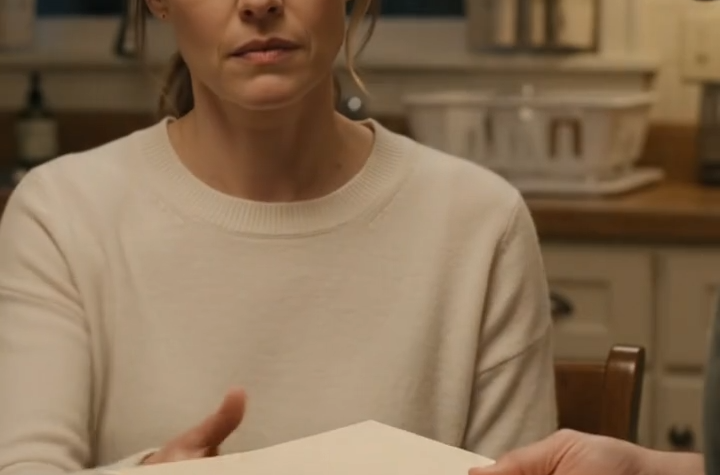
She stared at me.
I turned to Sophia.
“You said I need green?”
Sophia nodded solemnly.
“Here.”
She dipped the brush into the green watercolor.
Maria took one hesitant step forward.
“Mr.
Cole, you don’t have to—”
I raised my hand.
Not at Maria.
At Sophia.
“Go ahead.”
The little girl smiled.
Then she painted a green line beside the butterfly.
I sat there while she worked.
It should have felt absurd.
A man whose lawyers fought over contract language worth millions of dollars was allowing a three-year-old to use his face as construction paper.
Instead, the longer I sat still, the harder it became to swallow.
Because Sophia had said one sentence that no adult around me had dared say for years.
You looked sad.
People told me I looked successful.
Focused.
Tired, occasionally, if they were brave.
Driven.
Intense.
Nobody said sad.
Sad was too personal.
Sad suggested that all the things people envied had failed to solve something.
And they had.
My father had taught me early that vulnerability was an invoice somebody would eventually collect.
He had built his first business with borrowed money and permanent suspicion.
By the time I was old enough to understand what he did, I also understood his central rule: trust was expensive.
When I was seventeen, his company collapsed after a partner he considered a brother shifted money, lied about accounts, and disappeared before the lawsuits arrived.
My father never recovered emotionally.
Neither did our family.
He became harder.
My mother became quieter.
Arguments moved behind closed doors but still traveled through walls.
I learned to associate dependence with humiliation.
By twenty-two, I was building my own company.
By twenty-five, I had made more money than my father ever had.
By twenty-eight, I had almost eliminated the need to depend on anyone.
That was what I told myself, anyway.
The truth was less impressive.
I had eliminated intimacy along with dependence.
If I suspected an employee might leave, I tested them.
If a friend asked for help twice, I wondered whether the friendship had ever been real.
If a woman became interested in me, part of my mind immediately calculated what access to my life might be worth to her.
I could find betrayal before it happened because I never stopped looking for it.
The problem with expecting betrayal is that eventually you begin treating innocence like evidence.
That was what I had done that evening.
Maria had given me no reason to distrust her.
Sophia was three years old.
Still, I had closed my eyes and pretended to sleep because some part of me wanted to catch them becoming different when I could not see.
Instead, Sophia had caught me.