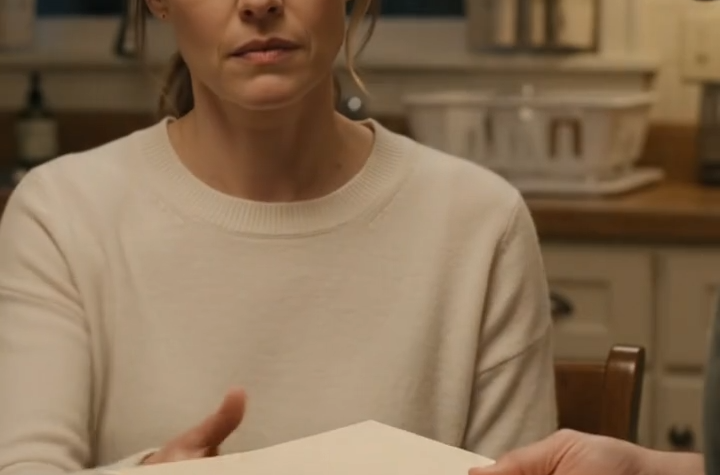
That landed.
Evelyn looked away.
Hale quietly informed us that nothing had been filed with the court.
Evelyn had been gathering material for a possible petition, but he had not agreed to submit it.
After hearing Lily contradict several statements attributed to her, he said he would not represent Evelyn in any guardianship action based on the information she had provided.
It was not the dramatic courtroom victory people imagine when they hear stories like this.
It was more important than that.
We had arrived before the machinery started moving.
Sarah asked for copies of everything concerning Lily.
Hale said he would handle the ethical and legal requirements appropriately and advised each side to obtain independent counsel if necessary.
Then I did the only thing that mattered immediately.
I took my daughter home.
Evelyn did not come with us.
That afternoon, Sarah and I sat with Lily in the family room while the old golden retriever slept against her feet.
We told her something we should have made unmistakably clear long before.
Adults are not allowed to make children responsible for adult secrets.
A surprise birthday present is one thing.
A grown-up telling a child to hide meetings from her parents because someone will be angry is different.
Lily listened quietly.
Then she asked the question that broke Sarah’s heart.
“Is Grandma going to be alone because I told?”
Sarah pulled her onto her lap.
“No, sweetheart.
Grandma’s feelings are Grandma’s responsibility.”
“But she said—”
“I know what she said.”
Sarah’s voice cracked.
“She should never have made you carry that.”
We found a child therapist who had no connection to Evelyn, not because we believed something was wrong with Lily, but because she deserved a neutral adult who understood how to untangle fear from loyalty.
We also changed the household arrangements immediately.
Evelyn no longer had unsupervised access to Lily.
The guest cottage was no longer an indefinite home.
Sarah told her mother she needed to move out.
Evelyn called it cruel.
Sarah called it necessary.
For several days, Evelyn sent long messages explaining herself.
Some were apologetic.
Others accused us of overreacting.
One said, “You will understand when Lily grows up and tells you how lonely she was.”
Sarah did not answer that one.
Instead she saved it for the family therapist she had insisted her mother see before there could be any discussion of rebuilding contact.
I also made changes.
Not because Evelyn’s accusations were accurate, but because beneath her manipulation was a vulnerability I had allowed myself to underestimate.
Lily noticed when I traveled.
She noticed when Sarah and I were distracted.
Children can be loved completely and still feel the shape of your absence.
So I stopped treating every business commitment as immovable.
I delegated more.
I blocked certain evenings completely.
Sarah did the same where she could.
We did not promise Lily we would never miss anything again.
That would have been another adult promise pretending life is controllable.
We promised something simpler.
She would always know where we were.
She could always ask why.
And nobody—grandmother, teacher, employee, friend, or relative—was allowed to tell her that loving them required hiding something that frightened her.