On uniforms, wealth, and fear convincing everyone that the suffering child was not their concern.
The baby finished feeding and relaxed against me.
I adjusted the blanket around her shoulders.
“What happens when we land?” I asked.
“Federal officers take him into custody.
My security division turns over the evidence.
You give a statement.”
“And after that?”
“After that, you do not return home alone.”
I felt anger rise through the fear.
“You don’t get to decide where I go.”
“No,” he said.
“But the people who received your photograph may already know where you live.
Until they are identified, returning without protection would be reckless.”
“You said it wasn’t a choice.”
“I was wrong to say it that way.”
The apology came so quickly that I stared at him.
He continued, “I was holding my daughter after nearly watching her die.
I saw your name transmitted to the people responsible.
I spoke like a man accustomed to giving orders.
Protection is your choice.
The danger is not.”
That distinction mattered.
I did not trust him.
Not yet.
But I believed his fear.
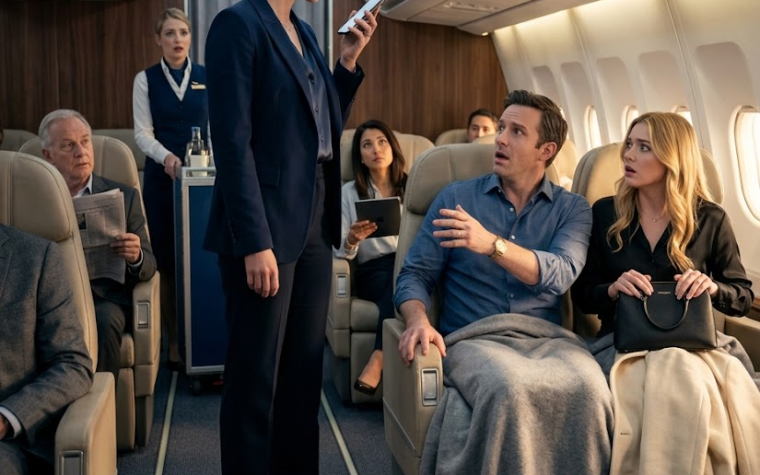
The aircraft began descending twenty minutes later.
The restrained guard had stopped talking.
Ethan’s agents photographed every piece of evidence and recorded a continuous chain-of-custody video.
The flight attendant wrote down everything she remembered about the bottles, the supply case, and the guard’s instructions.
I gave Ethan’s daughter one final feeding before landing.
When I handed her back, he supported her head carefully and held her against his heart.
“She needs a hospital,” I said.
“One is ready.”
“And she should be tested for anything she may have swallowed before I reached her.”
“She will be.”
The wheels touched the runway hard enough to shake the cabin.
Through the window, I saw emergency vehicles racing alongside us and dark federal vans waiting beyond the lights.
The guard finally looked afraid.
Officers boarded before the door was fully lowered.
They removed him in restraints, collected the contaminated bottles, the jammer, the navigation tablet, and his phone.
A medical team examined the baby inside the aircraft before transporting her to the hospital.
I went too.
Not because Ethan ordered me.
Because I could not leave without knowing she was safe.
The pediatrician later confirmed that she was dehydrated and dangerously low on blood sugar, but no sedative was detected in her system.
Her refusal to drink from the bottles had protected her.
My feeding had stabilized her long enough for the plane to land.
“She was lucky,” the doctor said.
I looked through the glass at the tiny child sleeping beneath a warm blanket.
“No,” Ethan replied.
“She was saved.”
The investigation lasted months.
The guard’s phone led federal agents to a kidnapping plan built around a manufactured medical emergency.
The drugged bottles were intended to make the baby collapse after takeoff.
The false ground-control instructions would direct the jet to a private airstrip, where armed accomplices expected Ethan to land without official emergency services or witnesses.