“The pearls must be placed on the table.”
Arthur Graves did not raise his voice, but the command traveled through the dining room with enough force to silence every whisper.
Savannah kept one hand pressed against the five strands at her throat.
“They were a gift,” she said.
Her eyes moved toward Grant, asking him to confirm it.
Grant recovered quickly.
He set down his glass and gave Arthur the patient smile he used whenever someone beneath him required correction.
“My mother intended for Savannah to have them.”
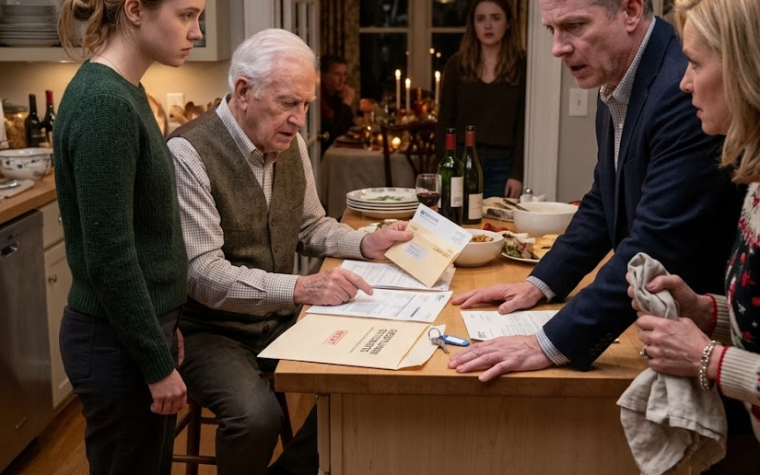
Arthur glanced at the open letter.
“No, she did not.”
The color left Savannah’s face.
Grant stepped away from his chair.
“You have no idea what my mother discussed with me privately.”
“I know what she signed in my presence,” Arthur replied.
“I know what she placed in the estate inventory.
I also know that this necklace was removed from the west safe three days after her death without authorization.”
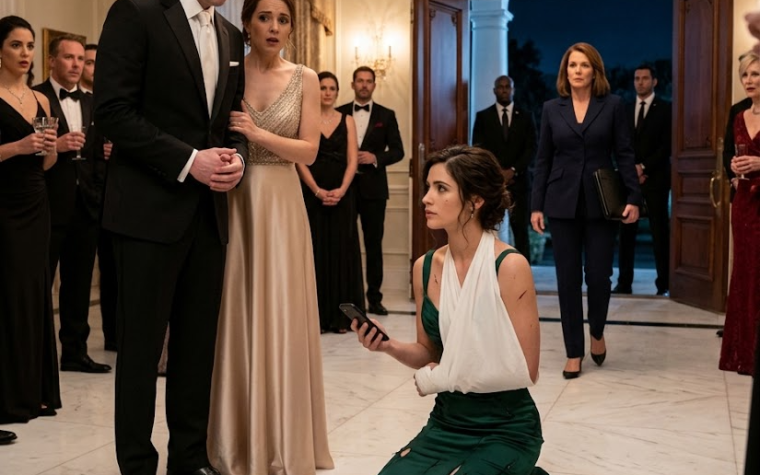
Every guest looked at Savannah.
She fumbled with the clasp.
Grant moved toward her, but Arthur lifted one hand.
“Do not touch the necklace.”
The quiet authority in his voice stopped Grant in the middle of the carpet.
Savannah finally opened the clasp.
The pearls slipped into her trembling palm.
For the first time that evening, she looked less like the chosen woman and more like someone who had arrived wearing evidence.
She placed the necklace beside Arthur’s plate.
The pearls settled against the white tablecloth with a soft, uneven sound.
Arthur returned to Beatrice’s letter.
“Mrs.
Whitmore instructed me to read this only after Grant spoke publicly about her final months.
Her words are as follows.”
He adjusted his glasses.
“‘My son has always mistaken control for loyalty.
He believes that if he tells a story first, loudly enough and in the correct room, truth will become impolite.’”
Grant’s jaw tightened.
Arthur continued.
“‘He will probably say my daughter-in-law manipulated me.
He may say she isolated me, controlled my care, or interfered in my affairs.
Those accusations are false.’”
A chair creaked near the end of the table.
No one looked at me now.
They looked at Grant.
He gave a short, disbelieving laugh.
“She was heavily medicated.
You know that.”
Arthur stopped reading.
“I anticipated that objection.”
He removed three documents from the leather folder and laid them beside the pearls.
“These are capacity evaluations completed on three separate dates by independent physicians selected without involvement from Grant or his wife.
Each physician concluded that Beatrice understood her assets, her relationships, and the consequences of her decisions.”
Grant stared at the papers.
Arthur turned to the guests.
“Her signatures were witnessed.
The meetings were recorded for legal verification.
Her daughter-in-law was not present when the estate documents were executed.”
Grant looked at me as though I had betrayed him by not being in a room he had accused me of controlling.
“You knew about this,” he said.