Another time, he suggested the situation might become easier after Sarah had adjusted.
That sentence ended my patience.
“Our daughter is not an inconvenience Sarah needs to adjust to,” I told him.
“When you are ready to be consistent, contact me.
Until then, do not enter and leave her life according to what makes your relationship comfortable.”
He accused me of being difficult.
I reminded him that consistency was not punishment.
Then I stopped arguing.
Life became wonderfully ordinary.
My daughter learned to roll over, then crawl, then pull herself upright using the edge of my drafting table.
She took her first steps toward a cardboard architectural model and destroyed three miniature trees before I could catch her.
I laughed until I cried.
I returned gradually to work.
Architecture had once been something I associated with Caleb because our careers had overlapped so closely with his development business.
After the divorce, I reclaimed it as mine.
I took smaller projects first.
Then larger ones.
I remembered why I had loved designing spaces before awards, clients, dinner parties, and Caleb’s ambitions had turned every achievement into something that belonged to both of us.
The gala invitation came shortly before my daughter’s second birthday.
It was an industry evening honoring regional design and development projects.
One of my projects was being recognized.
I knew Caleb’s company would attend.
I also knew Sarah would be beside him.
For several minutes, I held the invitation over the recycling bin.
Then my daughter ran through the kitchen wearing one sock and carrying a wooden block in each hand.
I laughed.
The invitation stayed.
I was finished surrendering rooms I had earned the right to enter.
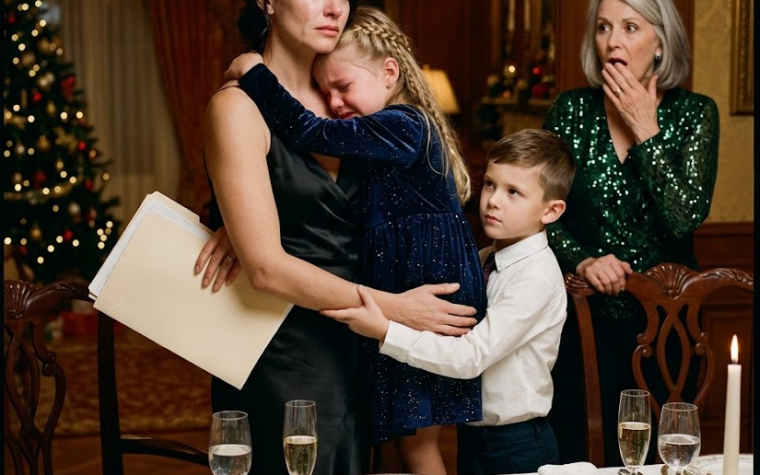
That was how we came to be standing beneath the chandeliers while Sarah stared at the child Caleb had postponed meeting for almost two years.
Caleb finally moved.
He placed his glass on a passing tray without looking away from us.
“Harper.”
My daughter tightened her fingers around mine.
“Hello, Caleb.”
Sarah’s eyes moved between us.
“Why didn’t you tell me she would be here?”
The question was directed at him.
“I didn’t know.”
“You knew about her.”
He hesitated.
That hesitation told me more about their relationship than I wanted to know.
Sarah’s expression changed.
“You knew she existed.”
“Yes.”
“For how long?”
Caleb glanced at me as if I might rescue him from the arithmetic.
I remained silent.
Sarah did the calculation herself.
Her mouth parted.
“Since the divorce?”
“Sarah, not here.”
“Since before the divorce was final?”
Caleb lowered his voice.
“We’ll talk later.”
I recognized the tone immediately.
It was the same tone he had used on me whenever he wanted control disguised as calm.