“Look at me,” she said.
His eyes returned to hers.
“Do you apologize because you understand what you did, or because you understand who saw it?”
His mouth opened.
Nothing came.
Elena nodded once.
“That is what I thought.”
She turned to the general.
“I am ready.”
He offered his arm toward the stage, not because she needed guidance, but as a formal courtesy.
“After you, Major General.”
Elena walked past her family.
This time, the guests did not move aside out of discomfort.
They made space with attention.
Some straightened as she passed.
Others watched the two stars on her shoulders catch the chandelier light.
The waiter who had frozen during the humiliation stepped forward and quietly removed the broken glass.
Elena reached the stage.
The general waited until she stood beside him, then approached the microphone.
“Ladies and gentlemen,” he said, “Major General Elena Ross.”
Applause began near the front.
It spread through the ballroom until the sound filled every corner.
Elena did not look toward her family.
She did not need their faces to confirm what had changed.
The applause was not revenge.
The stars were not revenge.
Even the general’s salute was not revenge.
They were evidence.
Evidence that the woman her family had reduced to a stain on a dress had built a life beyond their contempt.
When the applause ended, Elena stepped to the microphone.
She did not mention the wine.
She did not expose private history or demand sympathy.
She spoke about duty, judgment, and the responsibility carried by anyone entrusted with authority.
Her voice remained steady.
Her knowledge was exact.
Within minutes, the room’s attention had shifted completely from the confrontation to the reason she had been expected there.
That was the final consequence her family had not anticipated.
Elena did not need the humiliation to become the most important thing about her evening.
Her work was larger than what they had done.
When she finished, the audience rose.
Her father stood late.
Her brother stood because everyone else had.
Her mother remained seated for several seconds before slowly pushing back her chair.
Afterward, guests approached Elena one by one.
Some thanked her for her remarks.
Others offered restrained congratulations.
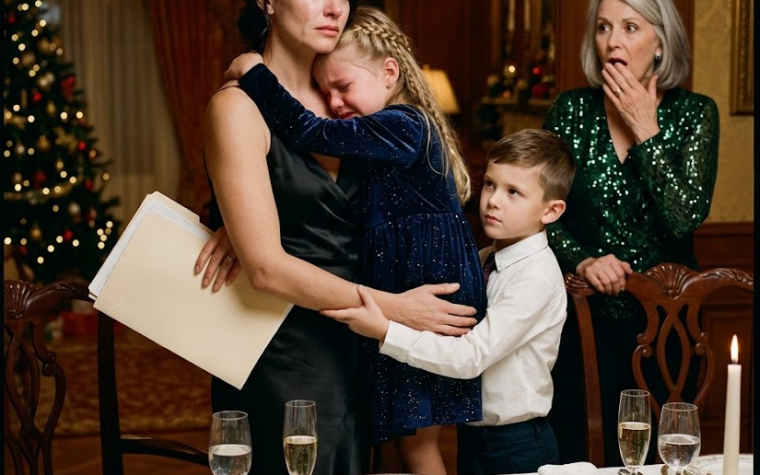
No one mentioned the scene directly, but several looked toward the stained dress still hanging over the chair.
The silence around it had become its own judgment.
Elena’s mother waited until the crowd thinned before approaching.
“Can we speak privately?”
Elena looked at her.
The confidence had left her mother’s posture.
Without the glass, the audience, or the family gathered behind her, she appeared uncertain.
They moved into the hallway.
For a moment, neither spoke.
Then her mother asked, “Why did you never make us understand?”