By evening, three directors demanded that I temporarily surrender executive authority while outside counsel investigated misuse of company funds.
I had built my public identity around the belief that no one could remove me from a room I owned.
Then the board voted, and I was escorted from my own office.
Vanessa was waiting in the lobby.
Her makeup was smudged.
She carried the jacket I had left in her apartment.
“I did not know it would become this,” she said.
I took the jacket but did not put it on.
“What did you think would happen?”
“That Claire would leave.
You would be angry.
Then eventually you would understand that we belonged together.”
I looked at the woman for whom I had missed dinners, ignored calls and lied without effort.
There had been no great love between us.
Only rooms where nobody expected anything honest from me.
“You were never the reason my marriage ended,” I said.
Vanessa’s face softened, mistaking the sentence for mercy.
“You were simply where I went while I was ending it.”
I walked past her.
My attorney, Leonard Shaw, met me at the penthouse that night.
He spent four hours reviewing the divorce file.
Everything was legal.
Claire had filed under her maiden name and requested protected contact information because of documented surveillance.
Service had been completed at my registered business office, then again through certified mail and finally through court-approved substituted service after I ignored the first notices.
My assistant had forwarded the documents to Victor.
Victor marked them non-urgent.
I had trained everyone around me to shield me from inconvenience.
Claire had used that machinery exactly as it was designed.
The divorce itself was simple.
She requested no share of the companies, no support and no property purchased with Moretti money.
She retained her inheritance, Blue Harbor and the personal possessions she brought into the marriage.
“She could have taken much more,” Leonard said.
“Why didn’t she?”
“Because this was not about punishing you financially.”
That answer hurt more than any demand could have.
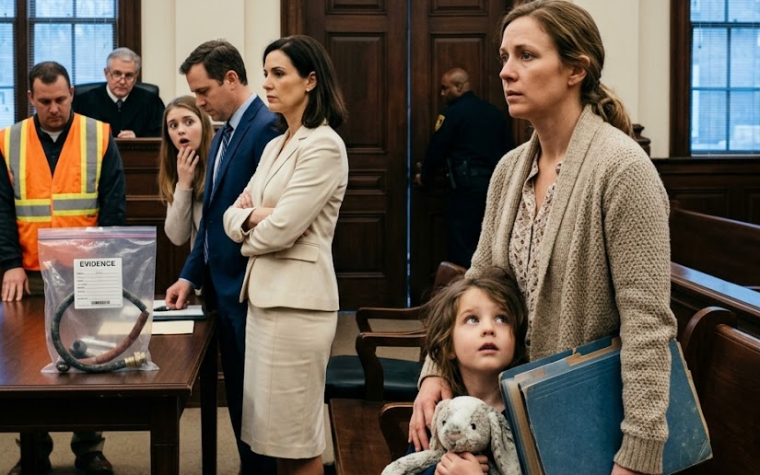
The first custody hearing occurred ten days later.
I entered through a private courthouse entrance with Leonard beside me.
Patricia waited inside the courtroom.
Claire sat at the opposite table wearing the cream coat from the photograph.
She looked smaller than I remembered and stronger than I had ever allowed her to be.
For years, she had stood half a step behind me at public events.
That morning she did not look in my direction when I entered.
The judge reviewed the temporary conditions.
No direct contact outside approved channels.
No surveillance.
No use of company personnel.
A psychological evaluation, parenting course and supervised visitation schedule would be required before any unsupervised contact could be considered.
Leonard whispered that we could challenge several conditions.
I watched Claire’s hand tighten around a pen.
“No challenge,” I said.
The judge looked at me.
“Mr.
Moretti, do you understand the order?”
“Yes, Your Honor.”
“And will you comply?”
I glanced at Claire.