At first, Wesley brought her only to the porch.
Then he started walking her inside.
He did not ask for money.
For many months, he did not stay.
One winter morning, almost a year after the dinner, he arrived alone carrying a paper bag from the bakery Arthur used to love.
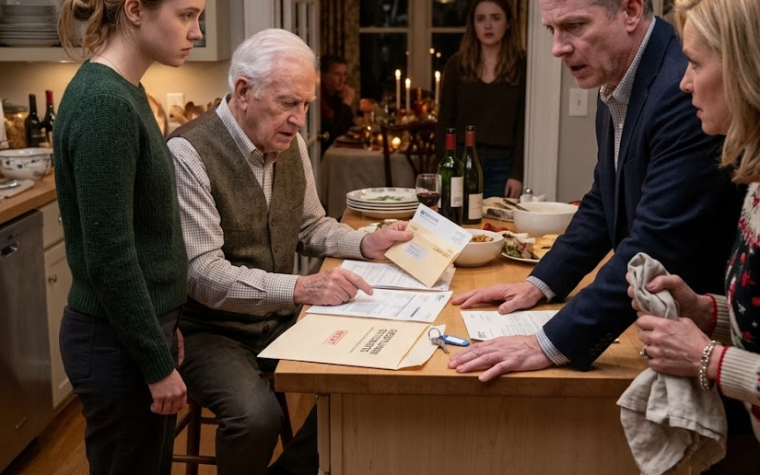
He placed it on the table and sat where Lydia had sat with the folder.
“I told her everything,” he said.
I knew he meant Serena.
“And?”
“She already knew most of it by then.”
He looked older.
Not ruined.
Not punished.
Simply responsible in a way he had avoided for years.
“I kept thinking you would turn the payments back on,” he said.
“Even after the house was listed.
I thought you would get scared and rescue me.”
“So did I,” I admitted.
He looked up.
“That first night, after I canceled them, I nearly called Lydia back.
I stood beside the phone for ten minutes.”
“What stopped you?”
I thought of Arthur’s photograph, the pearl earrings, and the message glowing in my hand.
“You did,” I said.
“You told me I was not invited.
For once, I believed you.”
He covered his face briefly.
“I am sorry.”
It was not the dramatic apology people imagine after betrayal.
He did not kneel.
He did not deliver a perfect speech.
He named what he had done.
He admitted he had hidden payments, lied to Serena, dismissed my loneliness, and treated my support as an inheritance arriving early.
Then he apologized without asking me to make him feel better.
That mattered.
Trust did not return that morning.
But something honest entered the room.
I made tea in the good cups.
Wesley noticed.
“You used to save those for company,” he said.
“I did.”
“What changed?”
I poured the tea and watched the steam rise between us.
“I stopped waiting for permission to enjoy what belongs to me.”
He nodded slowly.
Outside, the garden was bare, but the first green tips of spring had begun pushing through the soil near the steps.
Nothing dramatic.
Nothing anyone else would notice from the road.
Life returning rarely announces itself.
Sometimes it is only a good cup placed on an ordinary table.
Sometimes it is a folder finally opened.
Sometimes it is a mother saying no and discovering that love, stripped of payment, either learns to stand on its own or reveals that it never could.
Wesley and I never returned to what we had been.
That was not a tragedy.
What we had been required me to disappear a little more each year.
What came after was smaller, slower, and true.