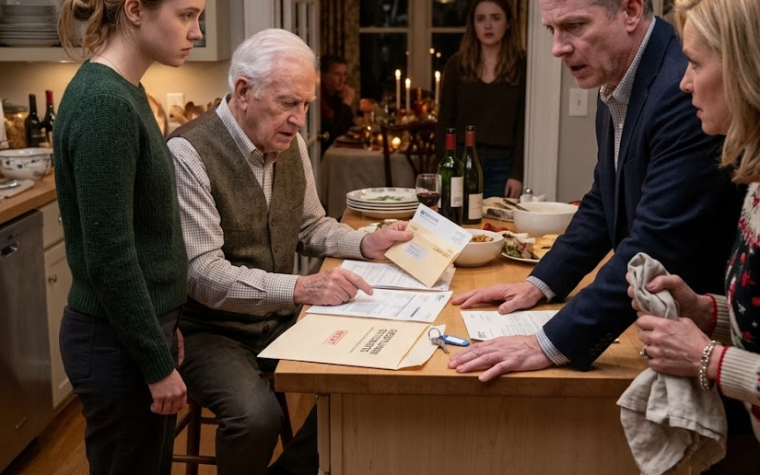
He stared at the porch floor.
None of them knew it.
Dad tried one final command.
“You will come to the wedding.
We will deal with the house afterward.”
“I won’t be there.”
“People will ask questions.”
“Answer them honestly.”
His expression told me that honesty was the one thing he could not imagine offering.
I closed the door.
They remained on the porch for several seconds.
Mom said my name once, softly.
Dad told her to get in the car.
Through the curtain, I watched them leave.
Saturday arrived.
I woke at eight, made coffee, and finished the last cabinet.
At noon, the time Dad had ordered me to appear, I was sitting on my kitchen floor tightening a loose hinge.
My phone stayed silent through the ceremony.
That evening, Brandon sent one photograph.
My parents stood beside him and his new wife beneath an arch of white flowers.
All four of them were smiling.
There was an empty space at the edge where I had been expected to stand.
His message said, Hope you’re happy.
I did not respond.
The notice period continued.
Through the attorney, Dad challenged every document and lost every argument.
He could not produce a deed, agreement, or account statement bearing his name.
The authority he had performed for years dissolved each time someone asked him for proof.
Mom eventually contacted me without him.
She did not apologize at first.
She asked whether she could have additional time to sort her belongings.
I granted a reasonable extension through the attorney, provided that they stopped coming to my home and communicated only in writing.
Dad called the condition humiliating.
I called it necessary.
Brandon blamed me for forcing our parents into a rental.
He said family property should have gone to the oldest son, then seemed to remember the property had never been his either.
When moving day came, Dad left without speaking to me.
Mom returned the keys at the attorney’s office.
She placed them on the table and stared at them for a long time.
“I really thought you were still in that room,” she said.
The confession was more painful than a lie.
“You never opened the door?”
She shook her head.
“I suppose I was afraid of what I would find.”
“You would have found an empty room.”
“I know.”
She cried then, quietly and without asking me to comfort her.
For once, I let her carry her own grief.
After they left, I visited the Miller house alone.
The rooms looked smaller without Dad’s voice filling them.
Pale rectangles marked the walls where family photographs had hung.
The dining room was empty except for the chandelier Grandma chose years ago.
I walked down the hallway and opened the door to my old bedroom.
Dust lay across the windowsill.
The closet was bare.
The room had preserved my absence perfectly.