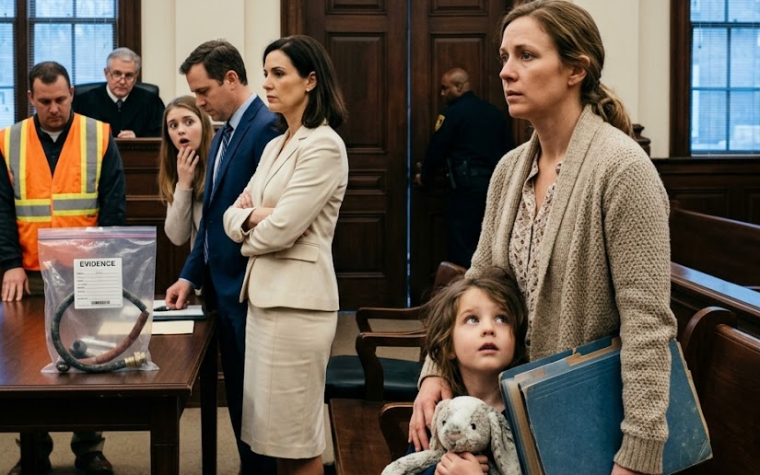
The first page of the document lay beneath the hospital security camera, its embossed seal shining under the fluorescent lights.
Warren remained silent on the phone.
For most of my life, silence had been my mother’s weapon.
She used it to keep arguments from becoming beatings, to keep neighbors from asking questions, and to keep Warren from turning his anger toward me.
But Warren’s silence was different.
It was the sound of a man recognizing a trap after hearing it close.
“What is that?” he finally asked.
I rested one hand on the blue folder.
“You said the house belonged to family.
I thought we should establish which family.”
“Mara,” he warned.
The detective beside me lifted a finger, signaling that I should keep him talking.
“Who notarized the deed Mom signed last night?” I asked again.
“A licensed professional.”
“Name?”
“I don’t have to answer you.”
Caleb muttered something in the background.
Warren covered the phone, but not quickly enough.
I heard my brother say, “She knows.”
The line disconnected.
The security officer set his tablet on a counter and opened the hospital footage.
At 2:41 a.m., Caleb’s black pickup appeared through curtains of snow.
It stopped outside the locked emergency gate.
The passenger door opened.
My mother fell onto the pavement.
Caleb climbed out wearing a heavy parka and gloves.
He dragged her upright by one arm, pushed her toward the gate, and returned to the truck.
Mom struck the glass door with both hands as he drove away.
She had no shoes.
No coat.
No purse.
The video had no sound, but I could see her mouth moving.
She was calling his name.
The security officer looked away first.
The detective did not.
He replayed the footage, paused on the license plate, and photographed the screen.
“Is that your brother’s truck?”
“Yes.”
“And this document?”
I handed him the first page.
Two years earlier, after Warren had tried to make Mom add him to the deed, she called me from a grocery store parking lot.
She whispered so softly I could barely hear her over the shopping carts rattling in the wind.
She said Warren had begun opening her mail.
He questioned every expense and monitored her medication.
Caleb had moved back into the house and started telling people that Mom was confused.
She was not confused.
She was afraid.
By then I was an estate attorney in Chicago, specializing in cases where relatives treated aging parents like bank accounts with heartbeats.
I had spent years helping strangers recognize the same signs I had ignored in my own home.
I arranged for Mom to meet an independent attorney in another county.
She created the Evelyn Hart Living Trust and transferred the Ashbury house into it.
She remained the beneficiary and trustee while she was competent.
If she became unable to manage her affairs, I would serve as successor trustee.
The recorded deed belonged to the trust.
Not to Warren.
Not to Caleb.