For twelve years, that tone had worked on me.
It was the voice he used after cruel jokes, missing money, unexplained absences, and promises he never intended to keep.
It invited me to become his accomplice in erasing whatever he had done.
That night, I finally recognized it for what it was.
“We already settled everything between us,” I said.
“The judge signed it at 2:17.”
Then I ended the call.
The next morning, I met with my company’s attorney and the bank’s fraud team.
Aurum House delivered copies of the authorization slip, security footage, reservation records, and transaction logs.
The footage showed Daniel presenting the duplicate card with complete confidence.
It showed him laughing as Vanessa tried on the necklace.
It showed him writing my name after the terminal rejected his own authorization.
The camera had captured his face clearly when the waiter asked whether the cardholder was present.
Daniel had answered, “She doesn’t need to be.
I handle her money.”
That sentence became one of the most important pieces of evidence.
He later claimed he believed his spouse access continued until midnight.
The timestamps disproved him.
The waiter had told him the linked accounts were restricted before he signed my name.
He had continued anyway.
The club permanently revoked his access.
The card issuer closed every profile associated with him and referred the attempted transactions for formal investigation.
My company filed a civil claim for unauthorized use of its account and the costs required to secure every financial system he might have known.
Daniel responded by accusing me of revenge.
His attorney stopped using that word after reviewing the footage.
Vanessa provided a statement confirming that Daniel had represented the company account as his own.
She also turned over messages in which he promised to buy the sapphire necklace after the divorce became final.
One message had been sent the night before our hearing.
“Tomorrow,” he had written, “I finally get everything she thought she could keep from me.”
He had planned the celebration before the judge signed the decree.
My father’s warning had not created Daniel’s decision.
It had merely prevented that decision from succeeding.
The legal consequences unfolded slowly.
There were interviews, document requests, sworn statements, and months in which Daniel tried to explain away evidence that became worse every time he spoke.
He eventually accepted responsibility for the forged authorization and attempted misuse of the corporate account.
The resolution required restitution for the club’s unrecovered charges, reimbursement of my company’s security and legal expenses, and penalties imposed through the resulting case.
His finances, already weaker than he had admitted to Vanessa, collapsed under obligations he had created in a single night.
The $640,000 necklace never left Aurum House.
The image of Vanessa wearing it survived only in the club’s security footage.
Daniel and Vanessa did not remain together.
I learned that through the case records, not through gossip.
She had believed she was stepping into a life of unlimited wealth.
He had believed she would continue admiring him once the borrowed access disappeared.
Neither belief survived the bill.
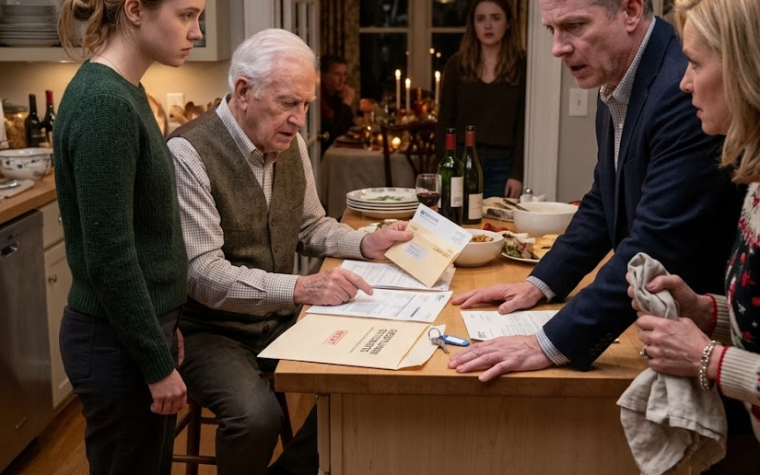
Months after the final documents were signed, my father came to my office carrying the same brown folder he had placed on his kitchen table.
Inside was the duplicate matte-black card Daniel had presented at Aurum House.
The bank had returned it after the investigation.
It had been cut cleanly through the magnetic strip.
Richard placed it in front of me.
“Do you want to keep it?” he asked.
I turned the pieces over in my hand.
For years, that card had represented the part of my life Daniel loved most: the rooms it opened, the service it summoned, and the impression it created.
He had mistaken every benefit beside me for proof that he controlled me.
“No,” I said.
I dropped both pieces into the shred container.
My father smiled, but there was sadness in it.