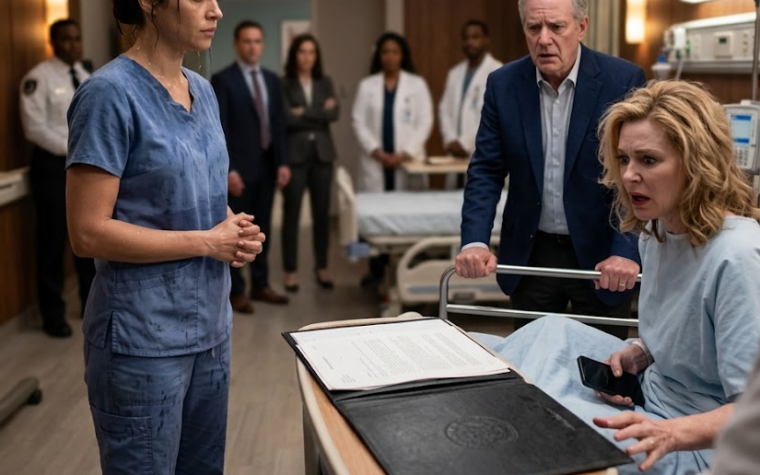
Helen did not look at Grant when she opened the navy folder.
She looked at me.
“Clara,” she said, “do I have your permission to discuss the documents you signed yesterday in front of these detectives?”
I nodded.
Grant stepped toward the bed.
“She has been sedated.
She cannot consent to anything.”
The older detective raised one hand and stopped him before he reached me.
Helen turned to the first signed page.
“At three fourteen yesterday afternoon, Clara Whitaker executed a new will in the presence of two independent witnesses.
Her physician had already confirmed that she was competent and acting voluntarily.”
Vanessa remained in the doorway.
Her fingers tightened around my mother’s pearl.
Grant tried to laugh.
The sound came out thin.
“My wife changes her mind every week.
Whatever she signed can be corrected when she is thinking clearly.”
“It cannot be corrected by you,” Helen said.
She continued reading.
The new will removed Grant as a beneficiary, executor, trustee, and guardian of any property inherited by our unborn child.
Everything I owned before the marriage—the investment accounts my mother left me, the apartment buildings held by my family trust, the beach house, the artwork, and my ownership of the yacht—would pass into a protected trust for my son.
An independent trust company would control the money until he was an adult.
Grant would receive nothing.
If my son did not survive me, the estate would pass to the maternal health foundation my mother had supported for twenty years.
Grant would still receive nothing.
The prenuptial agreement he had signed before our wedding prevented him from claiming my family assets as marital property.
Helen closed one section of the folder and opened another.
“The trust amendment was completed at the same meeting,” she said.
“It became effective immediately.”
Grant’s face changed.
Until that moment, he had been acting offended.
Now he looked frightened.
Vanessa noticed it too.
She lowered her hand from the necklace.
The younger detective asked, “Mr.
Whitaker, were you familiar with your wife’s previous will?”
Grant answered too quickly.
“Of course not.”
Helen removed a clear evidence sleeve from the folder.
Inside was a printed photograph showing the old will open on the desk in my home office.
The photograph had been recovered from Grant’s private cloud account that morning after I authorized access from my hospital bed.
The old will had been signed six years earlier, before I was pregnant and before I understood how carefully Grant studied the value of everything around him.
It had left most of my estate to my husband.
The photograph on Grant’s phone focused on one paragraph: the paragraph naming him primary beneficiary.
The detective looked from the photograph to Grant.
“When did you take this?”
“I did not.”
“The image originated on your phone.”
“Then someone sent it to me.”
Helen slid another page onto the blanket.
“The metadata shows it was taken in Clara’s office twelve days ago.”
Grant looked at me.
For the first time since Mateo pulled me from the water, he stopped pretending to be worried.
“You searched my phone?” he asked.
His voice was low and furious.
I remembered the first year of our marriage, when he had carried my shoes after a charity gala because my feet hurt.