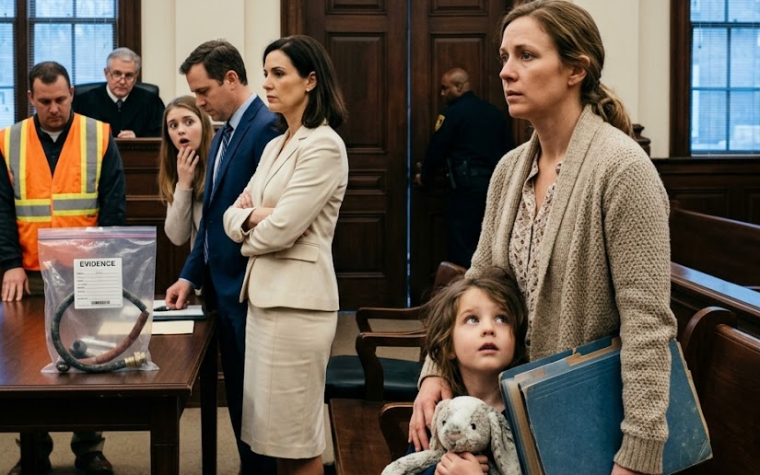
You said Emily would sign away custody once the doctors documented her breakdown.”
“Stop talking.”
“You said we would bring the baby home together.”
The officer moved between them.
Dr.
Alvarez touched my shoulder.
“Emily, we need to take you upstairs now.
The baby’s heart rate is reassuring, but you’re having regular contractions.”
The legal battle, the folder, and Preston’s unraveling suddenly became distant.
“Is she in danger?”
“Not at this moment.
We want to keep it that way.”
The nurses wheeled me toward the maternity elevators.
Preston called my name.
I did not turn around.
The elevator doors closed on his voice.
Upstairs, the world narrowed to clean sheets, monitor lights, and the steady pressure of Dr.
Alvarez’s hand while she examined me.
The contractions had been triggered by the fall and stress, but there were no signs of placental injury.
Medication and rest slowed them within two hours.
My ankle was badly bruised, my palm required bandaging, and every muscle in my body shook once I was finally alone.
Celia sat beside the bed while I cried without making a sound.
She did not tell me to be strong.
She simply placed a box of tissues within reach and waited.
“I nearly got on the stretcher,” I admitted.
“But you didn’t.”
“For a second, I thought refusing would make me look unstable.”
“That was the trap,” she said.
“Obey, and they controlled you.
Resist, and they called your resistance proof.”
I looked toward the fetal monitor.
“What happens now?”
“Now there are witnesses.”
By evening, the hospital had suspended all transfer privileges associated with Preston’s medical group.
Dr.
Mercer, the physician whose electronic signature appeared on the psychiatric hold, admitted through counsel that he had never examined me.
State medical regulators opened an investigation into the authorization.
The two medics surrendered their messages and dispatch instructions.
One contained a directive to prevent me from contacting relatives, attorneys, or outside physicians once I entered Hartwell Behavioral Institute.
Another instructed them to describe any refusal as aggression.
Savannah was questioned about the staircase footage and later arrested on an assault allegation.
Within forty-eight hours, her attorney began discussing cooperation.
She turned over messages in which Preston promised that I would be “legally neutralized” before the birth.
Preston was not led away from the hospital in handcuffs that morning.
Men with his resources rarely faced consequences in one dramatic instant.
Instead, the pressure arrived from every direction.
A judge issued an emergency protective order preventing him from contacting me or entering the maternity floor.
The court confirmed that I alone retained authority over my medical care and granted temporary restrictions on Preston’s access to our child pending further proceedings.
St.
Catherine’s referred the attempted transfer to prosecutors.
My attorney filed claims concerning coercion, unlawful restraint, and misuse of medical authority.
Preston’s company board convened an emergency meeting after learning that employees and corporate resources had been used to arrange the transport.
Three directors who had ignored his private behavior could not ignore the liability attached to his name.
He was placed on leave.
The announcement described it as a temporary governance measure.
Everyone understood what it meant.