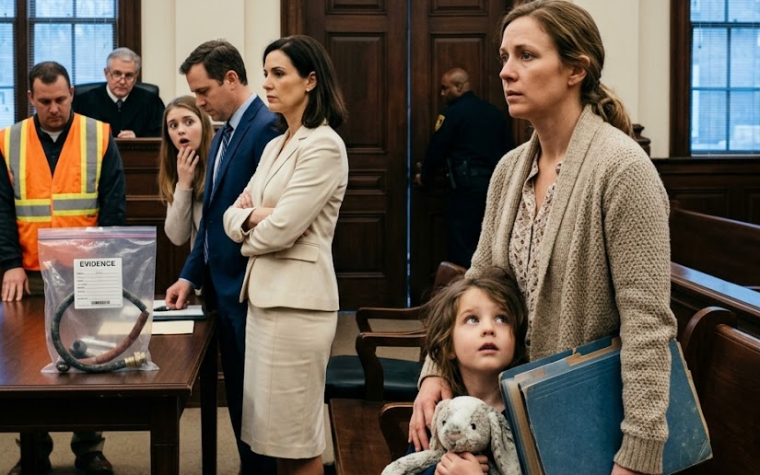
Marcus shook his head.
“I thought I could straighten it out.”
“With whose house?” Celeste demanded.
The judge warned her again.
But she was past embarrassment.
“You told me you owned everything.
The house.
The accounts.
That ridiculous car.
You told me she had nothing.”
Marcus looked around the courtroom as if searching for someone who still believed the version of him he had been selling.
Nobody volunteered.
Celeste’s voice broke into a scream.
“You lied to me!”
A bailiff shifted closer.
Marcus put both hands on the table.
For a second I thought he was going to argue.
Instead, his knees seemed to lose strength.
He lowered himself heavily into the chair, then turned toward me with an expression I had not seen in years.
Fear without anger to hide behind it.
“Evelyn,” he said.
Denise touched my wrist, reminding me that I did not have to answer.
Marcus tried again.
“Please.
We can fix this.”
The courtroom stayed silent.
He leaned forward.
“I made mistakes.
I was angry.
I thought—”
“You thought I couldn’t afford to fight you,” I said.
His face tightened.
“I shouldn’t have said that.”
“No.”
I looked at the folders covering our table.
“You shouldn’t have believed it.”
Then Denise handed the judge the final certified packet concerning the lender correspondence and the authorization issue.
That was the evidence that silenced the room.
The lender’s file reflected the attempted use of the house as collateral and the supporting representations made during a period when I was hospitalized.
My records showed I had not approved the transaction.
The trust documents showed Marcus lacked the unilateral authority he had behaved as though he possessed.
The judge did not dramatize it.
He simply read.
Marcus’s attorney stopped whispering.
Celeste stopped moving.
Even Marcus became still.
The court preserved the evidence, maintained the restrictions protecting the property, and made findings based on the documented financial representations before it.
Any issues outside the family court’s authority were left for the relevant institutions and processes to address separately.
For the divorce itself, what mattered was devastatingly simple.
Marcus’s story about our finances was not reliable.
His assumptions about ownership were wrong.
His attempt to pressure me into surrendering before discovery had failed.
And the woman he had promised my life to was finally seeing the invoices behind the fantasy.
The final financial resolution did not hand Marcus the house, the accounts, or a debt-free luxury SUV.
Property and obligations were handled according to the actual records, ownership documents, and applicable orders rather than the story he had rehearsed in my hospital room.
He left with consequences instead of trophies.