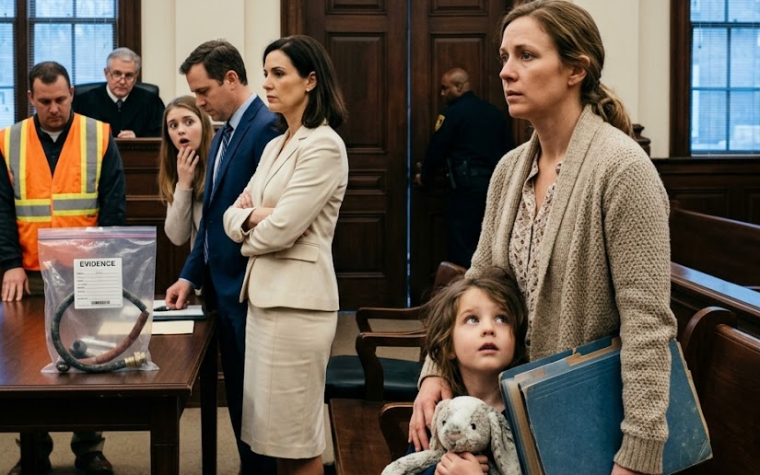
The conference-room door opened behind Preston before he could reach the document.
Eleanor Blackwood, the firm’s managing partner, entered first.
Her expression was grave, stripped of the polished warmth she usually reserved for wealthy clients.
Behind her came Martin Cole, the chief financial officer of Preston’s company, Hayes Meridian.
Martin carried a laptop and a sealed evidence pouch.
Preston stared at him.
“What are you doing here?”
Martin did not answer.
He took the empty chair beside Genevieve and placed the pouch on the table.
Victor Archer remained standing at the head of the room, one hand resting on the open black folder.
Preston looked at Genevieve again.
“Your father?”
The question came out with a laugh, but the laugh broke in the middle.
Genevieve met his eyes.
“Yes.”
“You told me your family was gone.”
“I told you we were estranged.”
“You said you had nothing.”
“No,” she replied.
“You decided that.”
The name Archer had always been there.
It had appeared on their marriage certificate, on old tax forms, and on the passport Preston once tossed into a hotel safe without reading.
Genevieve had never claimed to be an heiress.
She had never mentioned private aircraft, country estates, or the global infrastructure company her father had built from a regional construction business.
After her mother died, Victor had tried to organize Genevieve’s entire future with the same force he used to organize acquisitions.
He selected graduate programs, introduced acceptable men, and treated grief like a scheduling problem.
At twenty-two, Genevieve walked away.
She rented a room in Brooklyn, worked at a diner, and learned what her life felt like when no one was directing it.
When Preston met her, he saw worn shoes and an apron.
He never wondered why she spoke three languages, understood financial statements, or remained strangely calm in rooms full of powerful people.
He liked believing he had rescued her too much to examine the story closely.
Victor turned the first page in the folder toward Preston.
“This is a notice of default concerning Hayes Meridian’s senior credit facility.”
Preston glanced at it and pushed it back.
“That loan is held by Northstar Structured Credit.”
“Northstar is administered by Archer Private Capital,” Victor said.
“My family office holds sixty-two percent of the senior debt.”
For the first time that morning, Preston sat completely still.
Hayes Meridian looked like an empire from the outside.
Its glass headquarters occupied twelve floors in Midtown.
Its name appeared on luxury developments, transportation projects, and glossy business magazines.
But expansion had been financed with borrowed money.
Eighty-four million dollars in senior debt.
A twenty-two-million-dollar revolving facility.
Personal guarantees secured by Preston’s real estate, investment accounts, and vehicle collection.
He still controlled the company because the lenders had allowed him to control it.
Diane leaned closer to the notice.
“What is the alleged triggering breach?”
Victor looked at Martin.
The CFO opened his laptop.
“Three material breaches,” Martin said.
“Undisclosed related-party payments, false quarterly certifications, and a forged spousal consent attached to the 2024 collateral amendment.”
Preston’s chair scraped backward.
“That is a lie.”
Martin removed a document from the evidence pouch.
“This is the original consent submitted to Northstar.