My fingers closed around the lowest rung of the recessed maintenance ladder, and for the first time since Colonel Victor Kane’s boot hit my chest, I let myself believe I might live long enough to finish what NCIS had put me on the Resolute to do.
The ship was still moving.
Water hammered my shoulders.
My lungs felt scorched.
Every instinct told me to let go, kick clear of the hull, and wait for the rescue detail that should already have been in the water.
But the man-overboard alarm had taken too long to sound.
That delay told me everything I needed to know about how much control Kane still had above me.
I climbed.
The steel rungs were slick beneath my hands.
Twice my boots lost purchase.
The second time, the wake tore my body sideways hard enough to wrench my shoulder, but I held on.
At the top was a narrow maintenance recess beneath the aft deck, built for inspections and emergency access.
I dragged myself onto it, coughing seawater and trying not to make noise.
The alarm wailed overhead.
Boots pounded across the deck.
Kane would expect the rescue detail to look behind the ship.
He would expect me to be floating helplessly in open water.
He would not expect me to climb back aboard beneath his feet.
That was the advantage of being underestimated.
People stopped imagining what you could do.
I moved through the maintenance passage dripping seawater onto painted steel.
My chest throbbed where his boot had landed.
Breathing hurt, but nothing felt broken enough to stop me.
I reached the berthing level and heard voices outside.
“She went over the port rail.”
“Colonel says she lost her footing.”
I almost laughed.
Less than five minutes after kicking me off the ship, Kane had already started rewriting the story.
I waited until the passage cleared, slipped into the berthing compartment, and went straight to my bunk.
The sealed NCIS packet was where I had left it, taped inside the metal frame beneath the mattress.
The paper itself was ordinary.
That was the strange thing about evidence.
People imagined flashing lights, secret recordings, men in dark suits arriving at midnight.
Usually it began with paper.
A cargo number that existed twice.
A signature made by someone who had been ashore when the form was supposedly approved.
A pallet listed as engine components that weighed thousands of pounds more than engine components should.
A locked compartment on Deck Four that no ordinary logistics officer was allowed to inspect.
And a colonel who suddenly became very interested whenever anyone asked questions about it.
NCIS had been following those discrepancies before I ever boarded the Resolute.
The operation was larger than Kane’s treatment of the crew.
His ration cuts and public cruelty had attracted complaints, but cruelty alone was not why I had been inserted under a false logistics destination.
The investigators believed Kane had been using legitimate military shipments to conceal diverted disaster-relief supplies—water, antibiotics, portable generators, filtration equipment and other emergency material assigned to Pacific response depots.
The manifests said those pallets had already been transferred.
The weight records said they were still aboard.
The sealed packet contained the mismatched serial numbers, copies of the altered manifests, and an authorization allowing the ship’s command staff to open the restricted compartment if specific conditions were met.
One of those conditions was an immediate threat to a federal investigator.
Kane had just satisfied it in front of five hundred witnesses.
I pulled on a dry utility jacket, tucked the packet beneath it, and headed for Deck Four.
The alarm still screamed.
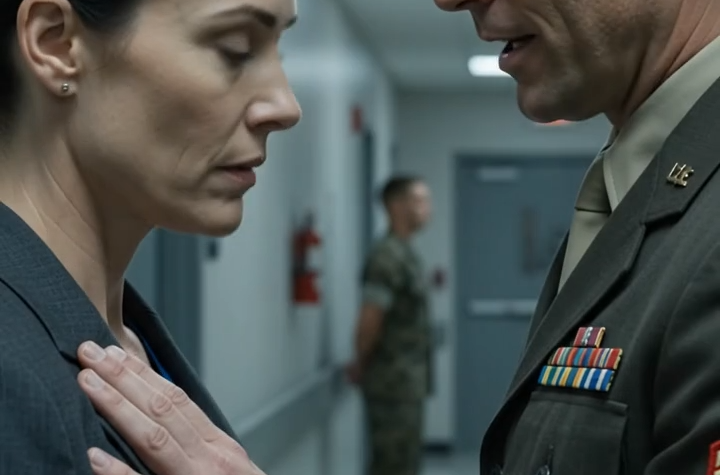
Halfway down the passage, a young Marine rounded the corner and froze when he saw me.
His face went white.
“Petty Officer Cole?”
I raised one finger to my lips.
He stared at the water dripping from my hair.
Then something changed in his expression.