Alistair looked toward one of his aides.
The aide opened a narrow leather case and removed a photograph.
The king did not hand it to Preston.
He handed it to me.
The photograph was old enough that the colors had softened.
A younger Alistair stood beside a dark-haired woman holding an infant wrapped in pale cloth.
Around the infant’s neck was my locket.
I stared at it until the image blurred.
“No,”
I said quietly.
Not because I thought he was lying.
Because believing him felt more dangerous.
Alistair seemed to understand.
He did not move closer.
“The photograph was taken six weeks before Amalia disappeared.”
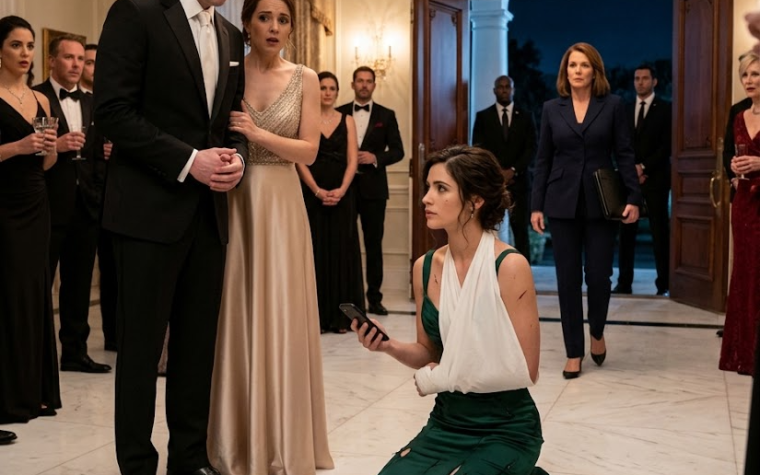
The ballroom had become so silent that his words carried to the farthest tables.
He explained only what he had to.
Years earlier, during a private visit connected to diplomatic travel in the United States, his infant daughter vanished under circumstances that had never been publicly resolved.
The Ardenian royal household had kept crucial identifying details confidential because false claims began almost immediately.
The exact design of the locket was one of those details.
Only a small number of people had ever known about the engraving inside it.
The king looked at me.
“And the hinge is damaged on the left side.”
I felt my stomach tighten.
It was.
It had always been.
Alistair continued.
“It was damaged when Amalia’s mother dropped it the week before the photograph was taken.”
I looked down at the locket in his palm.
Preston looked toward the cameras.
That was when I understood something about him that should have been obvious years earlier.
Even then, he was not thinking about me.
He was calculating what the room now thought of him.
Lydia approached carefully.
“Preston,” she murmured.
He ignored her.
“This is absurd,” he said louder.
“Claire has spent her entire life telling people she didn’t know where she came from.
Anyone could have researched this.
Anyone could have planted—”
“Planted it when?” I asked.
My voice stopped him.
He turned toward me.
I had worn that locket on our first date.
At our courthouse wedding.
In photographs from years before Preston had met anyone connected to international politics.
He knew that.
So did I.
His face changed as the same realization reached him.
King Alistair gave the locket back to me.
“This identifies a possibility,” he said.
“Not certainty.”
The restraint in his voice steadied me more than any dramatic declaration could have.
He was not claiming me because he wanted the story to be true.
He wanted it proved.
“So what happens now?” I asked.