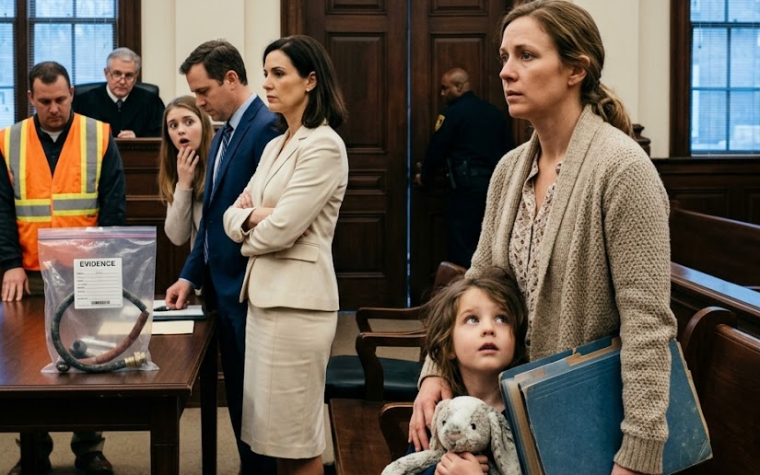
Eventually, expert review supported what Madeline had said from the hospital bed: signatures associated with critical documents were not consistent with genuine examples of her handwriting.
The insurance issue became especially damaging for Spencer because the amount—$3.5 million—was impossible to dismiss as casual paperwork once questions of authorization and signature authenticity were raised.
The financial investigation also supported allegations that substantial inheritance funds had been diverted from the purposes Madeline understood them to serve.
Spencer’s leverage had always depended on secrecy.
Once the secrecy was gone, he was simply a man surrounded by records.
Constance’s position deteriorated with his.
Her recorded approval of the assault, her statements afterward, and her communications with Spencer stripped away the elegant fiction that she had merely been an uninvolved mother protecting her son.
She had helped normalize the machinery that kept Madeline obedient.
The final reversal was quieter than I expected.
There was no cheering courtroom.
No dramatic speech.
Just a conference room, a stack of documents, attorneys, and Madeline sitting upright beside me.
For months, Spencer had insisted she could not manage money, could not remember accurately, could not survive without him, and could not withstand a legal fight.
Now settlement and criminal consequences were being discussed around evidence he could no longer intimidate.
His control over Madeline’s finances was broken.
Her claim to the property and diverted assets was aggressively pursued.
The fraudulent or unauthorized financial activity was placed in the hands of the authorities equipped to prosecute it.
The protective restrictions remained.
And Spencer’s carefully manufactured image of the polished husband with powerful connections had been replaced by documented allegations, recordings, financial records, and testimony he could not charm away.
Madeline did not look at him when she signed the papers that moved her another step toward freedom.
He looked at her constantly.
That was the difference.
He needed her attention.
She no longer needed his permission.
Months later, I returned to the condo with Madeline after Spencer’s access had been legally restricted and the property dispute had shifted in her favor.
The dining table was still there.
So was the tiny discoloration on the white cloth from the drop of water that had started the final unraveling.
Madeline stood beside it for a long time.
“I used to think that drop ruined everything,” she said.
I knew what she meant.
One tremor.
One mistake.
One punishment she had been conditioned to believe she caused.
“It didn’t ruin anything,” I said.
“It exposed something.”
She removed the tablecloth.
Not ceremonially.
Not angrily.
She simply folded it and put it in a bag to throw away.
Then she opened the windows.
Houston air pushed into the room, warm and heavy.
For the first time, she did not ask whether anyone else was comfortable.
On William’s next birthday, Madeline cooked the short ribs again.
Her hair had begun growing back into curls.
She wore short sleeves.
When she carried the water pitcher to the table, her hand paused for half a second.
I saw the memory pass through her.
Then she poured my glass.
A drop splashed onto the table.
Madeline stared at it.
So did I.
And then my daughter laughed.
Not because what happened to her was funny.
Because nothing happened next.
No chair scraped back.
No hand rose.