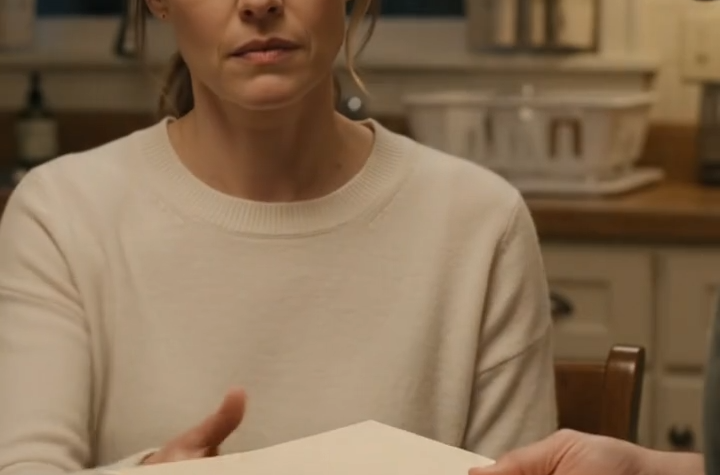
“You lost a job.
You didn’t lose your worth.”
He bowed his head.
I let him cry without touching him or filling the room with advice.
Sometimes comfort means refusing to make another person’s pain perform for you.
When his breathing steadied, I opened the cupboard and began putting away the groceries.
He stood and helped.
The eggs went into the refrigerator.
The pasta and soup went beside the remaining bread.
He held the coffee for a moment before placing it on the shelf.
“I haven’t bought coffee in two weeks,” he said.
“That explains the red eyes.”
For the first time, he laughed and meant it.
Before I left, I made him remove the tape from the first box.
He did it reluctantly.
“Only one,” he said.
“One is enough for tonight.”
He pulled out two shirts and placed them back in the closet.
The gesture was small, but it changed the room.
Ten minutes earlier, every object had been pointed toward departure.
Now one piece of his life had been returned to its place.
The next afternoon, Julián drove across town with the business card in his pocket and enough fuel in the tank to return.
The machine shop did not hire him immediately.
He filled out forms, answered questions, and waited.
For three weeks, uncertainty still followed him through the basement hallway.
But he no longer hid his car.
He came home before dark.
He stopped closing the door whenever he heard my steps.
The boxes remained beside the sofa for several days, then gradually disappeared as he unpacked them.
I did not ask him for rent during that time.
I did not remind him about the forty euros.
He reminded himself enough for both of us.
Every few days, he gave me an update.
“They called me back.”
“They want me to meet the shift supervisor.”
“They said there may be an afternoon opening.”
Each sentence carried a little more hope than the last, though he still spoke carefully, afraid that confidence might tempt disappointment.
Exactly three weeks after I opened his door, he knocked on mine.
He was wearing a clean work shirt and holding the business card between two fingers.
“I got it,” he said.
“The afternoon shift?”
He nodded.
His smile appeared slowly, as if he had forgotten how to trust one.
“I start Monday.”
I congratulated him and asked whether he had enough gas.
He laughed.
“Yes, Carmen.
I have enough gas.”
The work was not glamorous, and it was not the dream he imagined for his future.
It was stable.
It gave him regular hours, a paycheck he could count on, and the ability to buy groceries without calculating which meal he would skip.
After his first paycheck, he came to my door with an envelope.
Inside was part of the money he owed.
“You said after the first paycheck,” he reminded me before I could object.
“I also said not before.”
“This isn’t before.”