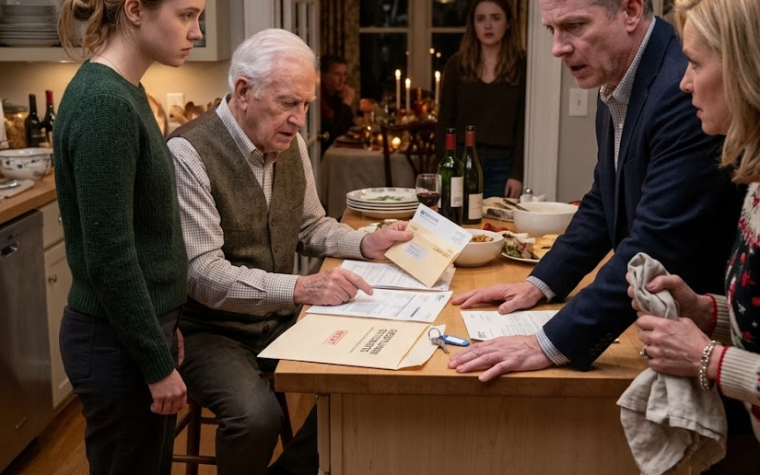
I had made the first report three weeks before my mother died.
At the time, I had not known whether anyone would believe me.
I submitted the vendor patterns, altered reports, and archive access concerns through the confidential channel.
Mercer requested supporting files and instructed me to preserve only records I was already permitted to access.
Then my mother’s condition worsened.
For several days, the investigation became less important than helping her drink water, adjusting her blankets, and listening when she woke frightened in the night.
She knew something was wrong at work.
She had seen me sitting at her kitchen table with spreadsheets open and my hands pressed against my temples.
“You keep waiting for cruel people to develop a conscience,” she told me.
“I’m trying not to ruin innocent people’s jobs.”
“Then don’t ruin them.
Tell the truth and let the guilty people ruin themselves.”
The investigator’s card remained beside my laptop.
On her final night at home, Mom picked it up and placed it in my hand.
“Promise me you won’t let them frighten you into silence.”
I promised.
Three days later, she was gone.
Standing in the office with Greg watching the auditors open file after file, I felt the weight of that promise more strongly than the flash drive had ever weighed in my palm.
The chief financial officer asked Greg to surrender his badge and company phone.
Greg refused.
“You cannot suspend me based on claims made by a terminated employee.”
Leonard Price stepped closer.
“You were suspended twenty minutes ago.”
For the first time, Greg looked genuinely stunned.
Leonard continued.
“The audit committee authorized it after learning you had attempted to terminate the primary compliance witness on the morning of her scheduled interview.”
Greg looked at Marissa.
“You told them?”
She flinched.
“I answered their questions.”
“You approved the termination.”
“You told me the executive committee had approved it.”
“They had.”
“No,” Leonard said.
“They had not.”
Marissa opened the severance envelope.
Behind the agreement was the authorization page Greg had sent her.
She handed it to Evelyn.
The signature at the bottom belonged to the company president.
The president was in Singapore when it had supposedly been signed.
Evelyn compared the signature with another file on the drive.
The shapes were identical—not merely similar, but pixel-for-pixel identical.
Copied and pasted.
A visible tremor passed through Greg’s jaw.
“That document was prepared by my assistant.”
His assistant, who had been standing near the printer, spoke without looking at him.
“No, it wasn’t.”
Every face turned toward her.
Her name was Tessa.
She had worked for Greg for eighteen months and had spent most of that time apologizing for his delays, rearranging his meetings, and absorbing his anger.
He stared at her.
“Be careful.”
Tessa swallowed.
Then she walked to her desk, opened a drawer, and removed a small notebook.
“You told me to backdate the meeting notes,” she said.
“I wrote down the date and time because I was scared you would blame me later.”