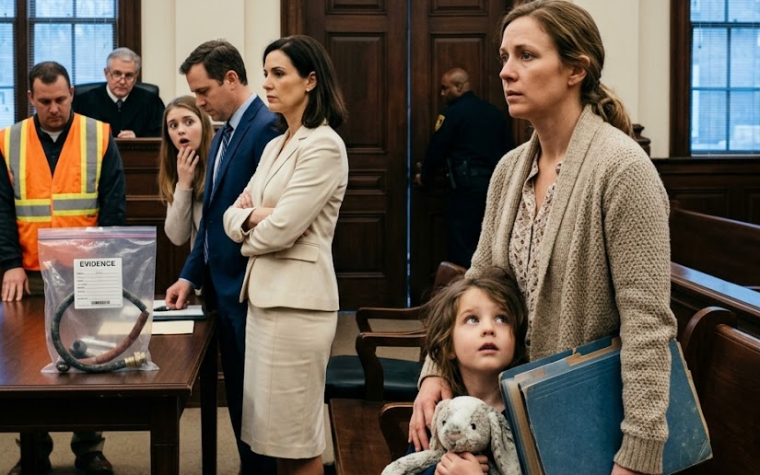
The judge saw it.
So did everyone else.
My attorney did not raise her voice.
“Your Honor, minutes ago he referred to the child as her brat.
He now calls the child his daughter when possession is useful to his argument.
We ask the court to consider both statements when evaluating his claim that he supports a healthy co-parenting relationship.”
His lawyer stood.
“My client spoke in frustration.”
“In front of a seven-year-old,” the judge replied.
The courtroom went silent again.
The judge called a recess so both sides could review the estate filing.
A clerk escorted my daughter and me to a small conference room with beige walls and a table scarred by years of nervous hands.
The moment the door closed, my daughter climbed into my lap even though she had grown too tall to fit comfortably.
“Am I the brat?” she whispered.
The question hurt more than anything her father had said about me.
I held her face between my hands.
“No.
You are not a word someone throws when they are losing control.
You are kind, brave, and loved.
What he said belongs to him, not to you.”
She studied my eyes, searching for any sign that I was only saying what mothers were supposed to say.
“Is that lady giving us a company?”
Despite everything, I almost laughed.
“She left me part of one.
I didn’t know.”
“Can you do it?”
For years, that question would have awakened my husband’s voice inside my head.
You have nothing without me.
You can’t provide stability.
You don’t really work.
But Eleanor’s letter sat on the other side of the wall, signed by a woman who had watched me make decisions before I learned to apologize for being capable.
“Yes,” I said.
“I can do it.”
When court resumed, Eleanor’s estate attorney was waiting in the back row.
He was a narrow man in his sixties carrying a leather case polished smooth at the handle.
The judge allowed my husband’s attorney to question him about the timing and authenticity of the filing.
He confirmed that Eleanor had signed the trust amendment three weeks before her death while two independent witnesses and a physician attested to her capacity.
The company’s board had unanimously approved the succession plan.
He had delayed notifying me because Eleanor’s instructions required the probate confirmation to occur first.
“Why her?” my husband’s attorney asked.
The estate attorney glanced toward me.
“Because Ms.
Whitaker believed she had already found the person she trusted to lead the firm.
She was waiting for that person to remember herself.”
My husband shook his head theatrically.
“Convenient.”
The attorney opened his case and removed one final envelope.
“Ms.
Whitaker anticipated that response.”
Inside was a copy of a letter my husband had sent Eleanor eight years earlier, when his company was close to failing.
He had asked her to persuade me to remain involved in the business instead of returning to outside employment.
My attorney read a line from it.
“She is the only person who understands the finances well enough to get us through this year.
If she leaves now, the company will collapse.”
I remembered that year.
He had told me returning to work would be selfish.