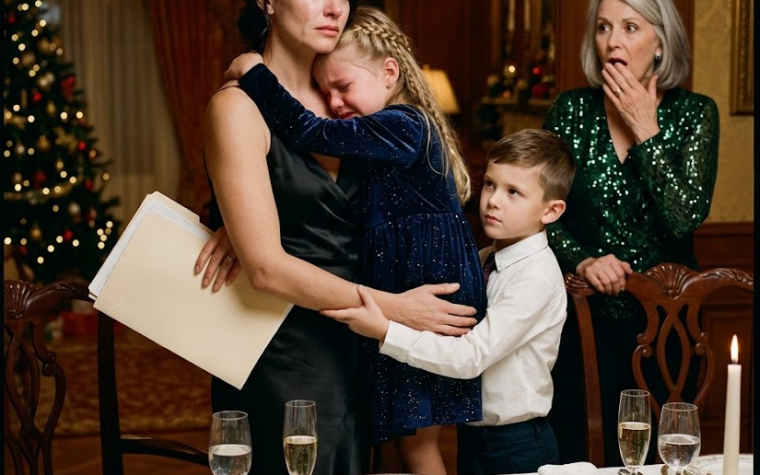
One of Andrew’s relatives leaned toward another and whispered something Charles could not hear.
The same witnesses who had magnified my humiliation now magnified his.
Andrew stepped beside Lily.
“It wasn’t a joke,” he said.
Charles’s expression sharpened.
“Andrew.”
“No.
You’ve been doing this all weekend.”
That surprised me.
I looked at Andrew.
He continued before his father could stop him.
“The comments about where Lily grew up.
The questions about Rebecca.
The way you kept talking about how Lily was marrying into stability, like she came from nothing and we were saving her from it.”
Lily’s face tightened.
Andrew reached for her hand.
“She didn’t come from nothing,” he said.
“She came from Rebecca.”
The room went completely still again.
I looked away because suddenly that sentence was harder to hear than the insult had been.
For years, I had measured success in ordinary things.
Rent paid on time.
A refrigerator with enough food.
A school permission slip returned before the deadline.
Lily asleep in her own bed, knowing someone would still be there in the morning.
I had never thought of those things as achievements.
They were simply what had to be done.
But Andrew had understood something Charles had not.
Money could provide comfort.
It could not rewrite who had stayed.
Charles set his champagne glass on the nearest table.
“This has become absurdly dramatic,” he said.
There it was again—the instinct to minimize whatever he could no longer control.
I almost let him.
Then I remembered Lily’s face when he called me a charity case.
So I spoke.
“You’re right about one thing.”
Charles looked at me.
“I did struggle.”
The room stayed quiet.
“I worked jobs I hated because Lily needed shoes.
I counted grocery money before I reached the register.
I went to class exhausted.
I made mistakes.
There were months when I had no idea how I was going to keep everything together.”
Charles folded his arms.
I continued.
“But none of that embarrassed me.”
His eyes narrowed slightly.
“What embarrassed me tonight was watching a grown man use a young woman’s abandoned childhood as material for a wedding joke.”
A few guests shifted in their chairs.
I did not raise my voice.
I didn’t need to.
“You weren’t insulting me when you called me a charity case,” I said.
“You were insulting Lily too.
You were telling her that the life she survived makes her less worthy of standing beside your son.”