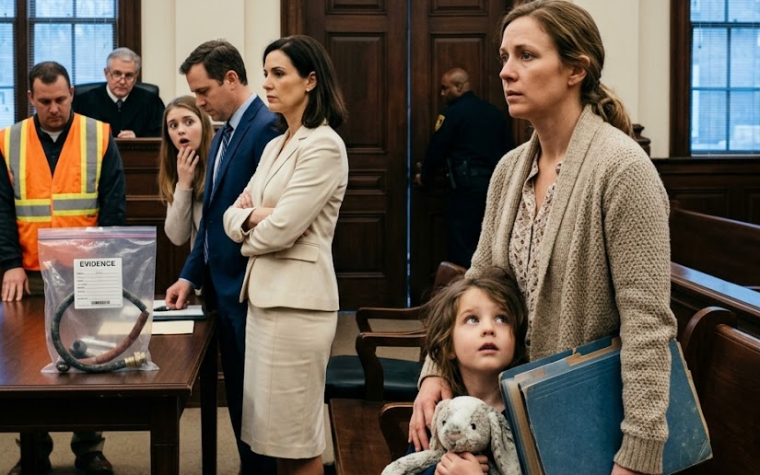
His small hand found mine beneath the table.
I did not answer with anger.
I asked Lena to show the next exhibit.
It was my original forensic report from the company’s first restructuring.
Before my marriage had reduced me to a quiet figure beside Adrian at charity dinners, I had built a career tracing hidden transactions through layered accounts.
I had testified in federal court before I turned thirty.
I had designed the financial controls that made Voss Meridian eligible for my father’s rescue fund.
The report contained my projections, my risk analysis, and my recommendations.
Adrian had presented many of those recommendations to the board as his own.
The board minutes proved it.
So did the metadata from the files, the emails I sent him, and his replies thanking me before he learned that public credit could be more valuable than private gratitude.
I had not merely funded his company through my family’s trust.
I had helped rebuild it.
Adrian looked toward the reporters in the gallery and understood that the story he had spent years constructing was collapsing in public.
He tried another strategy.
He claimed the altered schedule must have been created by a junior employee.
His attorney requested permission to withdraw it and replace it later.
The judge asked the CFO to stand.
Under oath, the CFO admitted that Adrian had ordered the finance department to prepare a version excluding the trust’s protective voting rights.
When the totals failed to reach the majority Adrian wanted, the CFO had warned him that the figures could not be reconciled.
Adrian instructed him to use the management incentive block twice and describe the difference as a pending allocation.
The CFO had preserved the email because he feared becoming the person blamed for it.
Lena asked whether Vanessa had participated.
The CFO hesitated.
Vanessa’s eyes widened.
He testified that Vanessa attended two planning meetings even though she held no position at the company.
She had selected the date on which the bridge loan would close and discussed using part of the remaining funds to renovate the mansion after I moved out.
Vanessa stood so quickly that her chair struck the wall behind her.
“That is not what happened.”
The judge ordered her to sit.
Vanessa turned on Adrian.
“You said your lawyers approved everything.”
Adrian’s voice dropped.
“Sit down.”
“You said Mara had no claim.”
“Sit down, Vanessa.”
“You said Ethan was the only complication.”
The words reached the microphone before she realized what she had said.
Ethan’s fingers tightened around mine.
Adrian closed his eyes.
Vanessa tried to correct herself.
She said she meant custody arrangements, not the child himself.
She insisted Adrian had described Ethan as emotionally dependent and academically delayed.
That gave Lena another opening.
She asked whether Vanessa had ever met Ethan’s teachers, attended a school conference, or reviewed any evaluation concerning him.
Vanessa admitted she had not.
The claim about his intelligence came entirely from Adrian.
Ethan was not intellectually disabled.
His teachers had repeatedly recommended advanced mathematical assessment.
He struggled in noisy environments, spoke less when anxious, and relied on counting patterns to steady himself.
Adrian had interpreted difference as deficiency because patience never served his ego.
The blueberries had not demonstrated Ethan’s weakness.
They had revealed his precision.
The judge called another recess, this time on her own terms.
She ordered the disputed corporate documents preserved, blocked the bridge-loan transfer, and referred the altered sworn exhibit to the appropriate authorities for review.
She also appointed a temporary guardian to ensure Ethan would not be subjected to further public humiliation during the custody proceedings.